Decisions: A database is built

Today, we made a decision about what to do with the contents of the box.

Heather at Documentary Site and I have been discussing, all though the beginning stages of this project, the kinds of things we could do with the materials in the box. As I noted last week, straightforward historical interpretation is one way we could go. But as we look through all the materials, and we read the notebooks, we both came to separate, but similar, conclusions.

It’s best that we create something that others can use to make sense of this story, ask questions about this period and time, and interpret from their own perspectives what it is they see.

Therefore, we’ve started a database.

This work is going to take some time. In the boxes’ journals, we have at least 7,000 entries for a database that we will make searchable by theme or keyword for others to use. We’ve decided to set up a domain exclusively for this project, and create an online archive. Some of the story will be interpreted through narrative text that will go along with a theme. But all of the entries will be made available for an audience to use to draw their own conclusions.

Posts about the box itself may dwindle during the time that we’re using for database entry. We’ve set up a shared spreadsheet, and we’ve each picked up a notebook. We’ll enter information by notebook, date of entry, the full text of the entry, and a series of tags we think best reflects the content of the entry. For example, on early entry on weather and cleaning chicken coops might be tagged “weather” and “chores.” We’ll try to make it as accessible as possible.

It also occurred to me during this discussion that I actually have a lot more material than what’s in the box for a database of this type. When I wrote More than a Farmer’s Wife, I interviewed or corresponded with more than 200 farm women who were born on or raised on farms between 1910 and 1960, and I kept it all. I actually couldn’t bear to part with it, because I could only use it for broad context and triangulation of data I gathered while reading farming and women’s magazines for the period in the book.

But the voices there, in the interviews and correspondence, need to be heard, in their own words.

We’ll be taking a hiatus from technical posts as we work on data entry, but I’ll still be posting about what we find along the way. I’m also taking suggestions for what our domain and/or project name could be. “What’s in the box?” is great for a start, but it doesn’t really describe the scope of what this project is becoming.

Off to the database.


What’s in the Box: Thinking about platforms

A critical question raised by Heather and myself in the last week is how we want to go about sharing the contents of the box with audiences.

Reading my last post about the box, Heather started to question whether I’d like to actually write a biography from the journals in the box. While I’m not really interested in doing that, I do think the chronicling of the material in the box could lend itself really well to that style of storytelling. However, we’re attempting to do something a little different here.

This led to a discussion about how to present what we’ve found, and whether we want to interpret it, or to lead others to draw their own conclusions about it.

Historians and journalists share a common role in that they’re tasked with interpreting the materials they find for a larger audience. As a former journalist who actively works as an historian, I tend toward this model of storytelling. It’s the sort of approach that invites others to share in what you’ve found, and what it means, but it also can be very direct communication. By the act of offering my interpretation, I assert that mine is the correct one.

However, one point I’ve learned over time is that my interpretation might not be the best or even the right one for the materials I’m uncovering. Each of us views the world in ways specific to our upbringings, cultural backgrounds, and value structures. As the granddaughter of Wisconsin farmers, I am confident that I share a great deal in common with the author of the journals in our box. But that doesn’t necessarily mean that my interpretation would be complete.

What would be better, perhaps, for an interactive documentary, would be to share the contents of the box wholesale, and allow viewers/readers to interpret what they find through the lens of their own unique experiences.

We’ve been thinking about digitizing the materials, and then sharing them in one unique place. We’ve been considering adding the chronicles, line by line, into a searchable database of some kind. We’ve also been considering imagery and how it would fit into the larger context of the work, and we’ve been considering how to tell the story offered by the box.

We’ve also been wondering whether there are other such chronicles out there that could be added to the archive we’re apparently building.

All of these questions drive our next steps.

To tell a story: Ways of approaching history

Thinking about “What’s in the Box?” has helped me focus a little on my other historical research.

When I first got the box, I was working on a large-scale history project. In fact, it might have been too large to do justice to the topic. It came from a place of wanting to learn about and share a story about how farm women in the United States lived and worked on their farms in the early to mid-twentieth century, rooted in my grief over the loss of my own grandmother just before I started my doctoral program and a parallel life-long interest in Laura Ingalls Wilder, who was writing for and about farm women at the time.

As with many questions that tackle aspects of women’s history, the first step had to be looking for their voices and stories. Several options could be employed. The first, which I used, is asking people for their own stories, informally networking to see if there was some written record that could be used to uncover the past. The biggest challenge in uncovering stories of the largely voiceless is that lack of voice; once many people have passed on, there’s no record they’ve even been a part of the past.

As a journalist, I loved to tell people’s stories. I learned in my teens that everyday stories had just as much impact and interest as the big news of the day, through work in state journalism workshops and camps. One of my first features that got significant attention told the story of a cleaning woman, Lorraine, in the dorm in which I was staying for camp. It ignited for me a passion to tell the stories that remained untold. And as a journalist before I became a historian-in-training, I thought to look first toward newspaper stories to see if I could find farm women’s voices from the period I was interested in, which started in 1911.

So my first project, in a classroom under the direction of Dr. Hazel Dicken-Garcia, was a paper that examined discourse about farm women in the St. Paul Pioneer Press. As a starting point, I used the first known publication date of Wilder’s column in the Missouri Ruralist, so that I had a known date when at least one farm woman was actively writing and engaged in the farming community. As an end point, I used the last known publication date for Wilder’s column, in 1926. That left fifteen years of Press coverage to comb through, so I decided to be methodical about it. I reviewed papers from harvest and planting seasons over that fifteen years, looking for farm women’s voices. I went through everything for that fifteen years.

And found exactly one item that directly mentioned farm women.

One.

In fifteen years.

I learned several things: One, that farm women truly were going voiceless in the mainstream media during this period. For some reason, this surprised me then, but with time, experience, and further research, I’m no longer surprised by this result. Two, that the Minnesota State Fair then, as now, recognized the role of farm women in the rural communities as being significant; the item that was reported came from its grounds, where new “rest room” facilities had been built on Machinery Hill for women to use. And three, that the lack of coverage in mainstream media didn’t mean farm women were totally voiceless; the item also interviewed the female editor of a magazine called The Farmer’s Wife.

In the absence of mainstream coverage, alternate and dissident press will appear, as this one did.

The Farmer’s Wife, I discovered, was a magazine published for many years in St. Paul. It is archived at the Magrath Library on the St. Paul Campus of the University of Minnesota.

The seeds of my dissertation are planted there.

Because of the lack of coverage, I realized I needed to discover the larger story of American farm women first. While some research had been conducted at this point, no one had looked at farming magazines at the scale I decided to try. I ended up looking at six different magazines–three farming, three national mainstream press–over fifty years that marked the shift in the United States from being mostly rural to being mostly urban: 1910 to 1960. Later, I sought out other means of finding these voices, including interviews and correspondence with women who lived and worked on farms during this period. It’s during this phase of the research, which was conducted to add to the dissertation for the book that was published in 2009, that I encountered the box.

On its face, I couldn’t use the materials within it for the research I was conducting at that time. The notebooks, at a glance, were fascinating, but ultimately beyond the period I was researching. I set it aside.

Now, looking at it again, I realize the box calls for a different style of storytelling. It’s not material that would lend itself to a large-scale project. It’s more in line with a biography–a piece of history that illuminates one person’s life that in some way tells a larger story about that person’s role in history. It calls to mind Laurel Thatcher Ulrich’s book, A Midwife’s Tale, which started with a similar diary chronicle to tease out a rich biography of Martha Ballard, a colonial midwife who lived in Maine and kept her diary from 1785 to 1812. (It won a Pulitzer Prize; it’s a brilliant book that I highly recommend.)

I don’t know what I’m going to do with those diaries yet. It’s a different sort of story, a different era from what I’m used to working in. And yet it’s very, very familiar.

What’s In the Box? Looking at old photographs

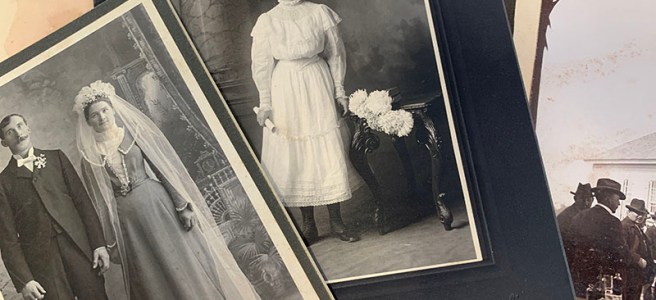
I’m looking at the photographs in the box today. Two are loose; three rest inside the cardboard-bound album. My first thoughts surround what people are wearing in the photographs, but I’m finding it difficult to separate myself and my thoughts from my impulses to preserve. I’m not using gloves as I handle these, though I am using dry, clean hands. I can tell that someone took great care of these; the yellowing that might indicate acidic based paper really only is present in the cardboard case.

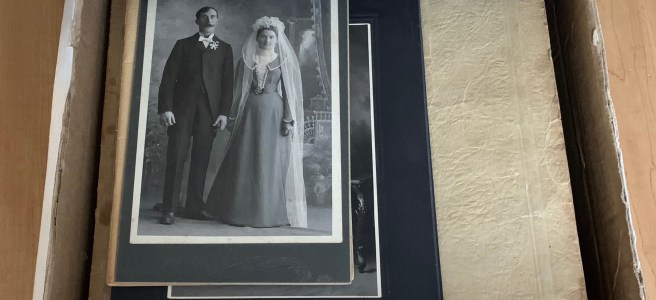
The wedding photograph, mounted on a gray heavy card stock, is labeled “Henry and Selma Kolb” on the back, in pencil, in writing that clearly was influenced by the Palmer Method.  It’s relatively easy to date the photo; photographs of this quality were not available until the mid to late 19th century, for one. I decide to look at the family genealogy book to see if I can find a better date for the photo before I look any further, and I find them.

kolbgen

Henry and Selma Kolb were married Nov. 30, 1899. They had two children, and by 1963, they had five grandchildren and nine great-grandchildren.

The photo is in black and white. It’s not yellowed as much as it could be; the photo paper and the mounting board appear to be high quality.  There’s an imprint on the bottom border that I can’t make out; I use a soft pencil and a piece of paper to make a rubbing of it.  It reads: “E & A Kreuter 1212 N. 8th St Sheboygan Wis.”

Sheboygan, again. Our clues are getting bigger all the time.

Still, 1899 makes sense. Henry’s outfit would not be out of place at a formal event today; his suit and shoes are dark, and his jacket cut in a slight wave over his hips with short tails. He’s wearing a stiff white collar and a white bow tie, with a white cluster of small flowers on his lapel. He wears no beard, but has a lovely, well-kept handlebar mustache.

Selma’s gown lacks the fuss of an upper-class Victorian gown, which could indicate her place in a lower class or a nod to more modern styles, which were beginning to trend toward slimmer lines and less fuss. I can’t tell what color it is, but it’s a shade that reflects as a deep gray, so it might be blue. It might be deep pink. I make a mental note to research Victorian wedding colors as I look at the white, high-necked blouse that rests under a jacket that matches the skirt, with lace at the edges and a bow tied sharply at the waist. Her hair is up, and crowned with a headpiece that is floral, with ruffled veiling off the top that leads to a floor length veil. It’s gorgeous.

The pair make a beautiful couple. Neither smiles, but that’s not uncommon for this era. Some preferred not to show imperfect teeth. Some were coached to keep their mouths closed as a means of keeping themselves relaxed and still for what could be a long exposure time. Selma, however, looks like she’s trying very hard not to smile as brightly as she can. There’s a suggestion of dimples there, and eyes that look like they could laugh at any second.

Elsa Muetzelburg Neumann peers out of the other single-frame photo. She’s got a Palmer method label, in ink, on her back. The ink’s not bleeding, and it appears to have been done recently, with some kind of ball-point pen. She’s labeled “Elsa” in the genealogy, but her granddaughter, our correspondent, refers to her as “Elsie.” Elsie is who we think kept the journals. Her record indicates that she was born Jan. 14, 1892, married June 14, 1913, and died Nov. 29, 1983.

The genealogy has more ink on this page, than on the others, and I think her granddaughter wanted to fill in the blanks.

Elsa’s picture clearly is taken when she was still a teen, certainly well before her 1913 marriage. Her gown is the filmy white cotton or linen characteristic of a well-bred girl’s graduation wardrobe, though it shows considerable ankle. The scroll she holds in one hand bolsters the impression that this is her graduation photo. If she graduated at 18, which is not a given, this photo would have been taken in about 1910. The imprint reveals another, different Sheboygan address.

The third set of photos comes in one, cardboard album. It’s hand sewn at the edges, and labeled on the front. It came from Fred Kolb, who proudly declared himself “teacher” on the front cover in iron-based ink. This album has seen better days. It’s spattered with liquids that left stains behind, and the photos are going pink with exposure to the cardboard on which they’re mounted. The photos are attributed to a photographer in Wells, Wis., but close attention to the content of the photos places the pictures in Meeme, Wis., which is close to Sheboygan.

A quick check of my phone’s map feature tells me Meeme is 18 miles or so from Sheboygan, a day’s ride by horse; a twenty-minute drive today.

The genealogy tells me that Fred K. Kolb, the teacher at Meeme on Memorial Day 1899, born in 1872. He was 26 in his dignified teacher’s pose, in a classroom decorated with buntings. Another photo in the set, of all his students, is marked with ink in three places. One marks out a little girl who might be Elsa. It’s hard to tell. Fred married in 1906, to Laura Post, and the couple had three children.

So much can be gleaned from the photos. So many stories can be told.

Tips on photo preservation: If you’re interested in preserving your old photos, now is the time to get them copied on acid- and lignin-free paper. Keep them in low light and handle them carefully with clean, dry hands. If you’ve got old insta-photos, the kind that came from Polaroid or Kodak instant cameras, take this step immediately. The chemicals that help produce the instant images will wear out over time, and your images will be lost. Doing this would make a great gift for your family archivist.

The Ephemera of History: The box yields some secrets

I love handling the artifacts of history. There is something about laying hands on something people ages ago owned, or held, or wrote, that inspires awe. I feel connected with these people whom I will never meet, in a way that helps me to “see” their stories.

Opening the box the first time, more than a decade ago, felt like that. At the time, I didn’t have a place for these things, so I kept them carefully sealed in the box to preserve them for the future. And now, I’m opening it back up.

The letter on top originally came from my desk. A query had been sent to me about whether I’d like the materials, and I’d responded with a note that I’d love them. That I would make copies and return them. Unfortunately, when they came, there was no return address and the original letter had been lost. (If this was you, I’m still ready to keep my promise.)

Handwritten on the bottom of the letter: “Here they are–nothing special yet they show the hard work Grandma Elsie [middle name, last name] did even in her 50s.”

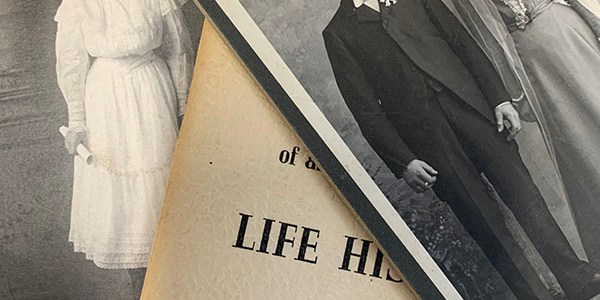
I can’t quite make out the middle and last names–they’re long, and I could make a good guess, but I’m not ready to name the person who created these materials yet. The next set of pictures, though, have legible names: Henry and Selma Kolb, next to a booklet titled “THE STORY of an EPOCH in the LIFE HISTORY of a SEGMENT of the KOLB FAMILY.”

Then came a general genealogy of the Ernst Kolb family that begins in 1761 and ends in 1961. I immediately am reminded that I want to get these materials back to their family, if someone in the family wants them. The historian in me can’t imagine they wouldn’t.

Next, I found an album bound in cardboard, labeled “Memorial Day, 1899” for Dist. V, Meeme, by Fred. K. Kolb, Teacher, with a clue–two large class photos printed by H.C. Benke in Wells, Wis. Then, a newspaper clipping from 1974 about the farm on which my sender’s grandmother lived and worked from 1892-1983.

Then, I find the notebooks.

notebooks

Ledgers, “theme” books, and familiar spiral bound notebooks filled with observations that began in 1955 and ended in 1978. The first entry reads,  “Jan. 1955. New year went to church. In P.M. went to Karls and in eve called on Ewald  O—. Sun to arrive for dinner. Mon Jan 3, 42 [degrees], scrubbed chicken coops.”

There’s a note every few days, written, I think, by the “Grandma Elsie” referred to by my sender, whose name can only be read as “Judy.” I glanced through several entries, then forced myself to stop. I can easily be lost in archives, and this one seems rich. A baby born in July 1956. A cutting of grain. Checks received for crops. All recorded here by someone who thought keeping such records was important.

I do wonder if she wrote anything before 1955, and what happened to those diaries. If Elsie did live and work on that farm for more than a hundred years, retiring in 1974, then I have to wonder why I only have twenty years of diaries in the box. Maybe the rest were thrown out? Maybe these notebooks were only hastily rescued by a granddaughter who hoped someone might use them? Maybe there are more.

Heather, my partner at Documentary Site, couldn’t read any of the handwriting. But it’s mostly legible to me, classic Palmer Method-style handwriting familiar because it’s my grandmother’s, too. It’s the style of handwriting taught in the one-room schools in Wisconsin, the style first taught to me in third grade in Mrs. Weinzerl’s room in Luck, Wis. Already, in 1980, it was going out of style; my cousins in Madison, Wis. during the same period learned the kind of upright cursive that starts with forming print letters with small hooks.

So, as I said, I can make a guess as to the last two names, but my next step is to try the permutations of those names in Google to see if I can triangulate my search for the rightful owners of this box. I know the farm was in Wisconsin. But at the time of my research, I lived in Kansas, and I was under the impression that the owner of the box lived fairly locally.

It’s a bit of a mystery, but now I have a place to start.

Remembering the Peshtigo Fire

October 8, 1871–Fire rampaged through northeastern Wisconsin, wiping out the city of Peshtigo and claiming the lives of an estimated 2,400 people. Though the fire occurred on the same day as the Great Chicago Fire, with greater loss of life, very little is known about it outside of Wisconsin.

That conundrum (How can something so devastating be so forgotten?) led me down many paths over the course of my career. My imagination first got caught up with the fire in fourth grade, when I wrote about it in an illustrated manuscript that took a prize at the Wisconsin State Fair. But later on, when I became a reporter in that same region, covering the city government for the city and towns of Peshtigo, I was able to dig deeply into that history and report about it in a series of stories that ran the week that began with Monday, Oct. 7, 1996, commemorating the 125th anniversary of the fire.

I started looking through the clips of the series recently, which I’ve kept as examples of enterprise reporting and as groundwork for more potential research. I wrote the story in five parts, one for each day that week, with Tuesday’s pieces focusing on the story of the fire itself and published on its anniversary. Those pieces were edited together and picked up by the Associated Press for national distribution, one of the few of my early works for which that happened.

The entire week also represents the first time I allowed myself to spread my wings as writer, using descriptive language to tell a story that few knew well, and fewer still know well today.

“Modern day Peshtigo bustles with life and industry. People in the city smile as others pass. A thriving industrial park attracts the cream of business and industry. Badger Park beckons the lunch-hour patron as well as the children of the nearby elementary school … It’s such a pretty town. With such a horrifying history.” (Lauters, EagleHerald, Oct. 7, 1996)

I went on to describe the town, the drought, and the lack of communication lines from the north to the south because of wild fires that were breaking out due to construction of railroad lines through the dry woods. I used original source material that included local residents’ recollections of survivor stories, survivor diaries, and my own newspaper’s archives. I finished that day with the line from an editorial by 1871 Eagle editor Luther Noyes: “Fires are still raging all over the country. The raw air of autumn is being well-cooked by fire.” (Eagle, Sept. 24, 1871)

Noyes’ words were prophetic. On Tuesday, Oct. 8, 1871, as the Rev. Peter Pernin writes in his diary, a muffled roaring sound came from the west. He knew instantly that he needed to head to the Peshtigo River. Mill workers on the east side of the river already were battling sparks and flames there, but by 9 p.m., most workers’ families were in bed.

Then flames rose from the rest along Oconto Avenue, and engulfed everything in their path. Bells rang all over town. As many as could do so headed for that same river, hoping that the water, shallow with the drought, could save their lives. Pernin writes about struggling on the bridge over the River, as people from both sides of it tried to get to the other, hoping for safety, and that he managed to push himself and his cart–containing the Tabernacle that housed the Sacrament–into the water itself, immersing them both.

“I came out of that river about half past three in the morning, and from that time I was in a very different condition, both morally and physically, to that in which I had previously been,” Pernin wrote.

Pernin wasn’t alone. Fire conditions were said to be so hot, many people simply blazed up when the flames hit them. A final death count would be impossible for this reason, and because no one knew just how many people were in the region at the time.  A census would show only homesteaders and citizens; the area, however, was filled with railway workers and others who’d just arrived from Chicago for the work promised in the region.

Nothing but ashes, and a single green-timber framed house, remained in the entire city.

I interviewed numerous descendants of fire survivors, and their stories ran the next day. I wrapped the series with what amounted to an annotated bibliography of sources for those who were interested in learning more.

The experience fired my imagination. Resources were sent from Wisconsin to Chicago, to aid residence there, before the state government even knew about their own devastation. The governor’s wife, in residence in Madison while her husband headed to Chicago, commandeered an aid train and sent it north when word reached her.

The papers covered Chicago.

The history illustrated numerous things for me, but one thing was made manifestly clear: Coverage of events can only occur if someone knows the event is happening, and if that event is judged to be significant enough to an audience.

Chicago as a large city, wiped out, remained the story of the day. The small town wiped out in northern Wisconsin hardly rated, in comparison, despite the loss of life. Already in 1871, regional differences in urban and rural markets for coverage became apparent.

But it’s important to remember the tragedy at Peshtigo for numerous reasons. The city today, is small, but it thrives. The region prospers. Out of the ashes, hope survived.