On Family Foods and Ethnic Ties

I’ve been cooking and baking nonstop for the last week. I’ve gone through ten pounds of flour, four pounds of butter, and innumerable eggs. I’ve made dips, cookies, bread, meatballs and many other lovely things, and I’m not inclined to stop until the New Year.

Part of the reason for the kitchen flurry lies in the season. We celebrate Christmas, and many of our food traditions show up at this time of year. Ethnically, I’m British, German, Danish, and Swedish, primarily, and when I look at my holiday menu, I see the ripples of those traditions settle on my plate. I’ve always been the primary cookie baker at Christmas in the family, and I certainly made a dent in my usual list: butter cookies, Russian tea cakes, peanut butter bon-bons, and peanut butter kiss cookies all appeared on my table—and disappeared from it. I made garlic-artichoke dip and olive tapenade, and baked fresh French bread for those allergic to soy and corn in the family.

Most of these recipes are family favorites I picked up here and there over the course of a lifetime. The bon-bons? Middle school French class. Tea cakes? Middle-school home economics class. Peanut butter kiss? My cousin’s Grandma Elaine. Butter cookies? Who knows? But they’re a staple on all German and Scandinavian holiday tables.

The garlic-artichoke dip comes from an editor at my first professional newspaper job. She brought it hot and bubbling to each gathering, and it was luscious. I never got her recipe, so I’ve been playing with it ever since, trying to get it right. I think I’m close. The tapenade was a suggestion from my earliest viewings of the Food Network. I think it might have been a Cooking Live Primetime recipe.

But other foods clearly come through an ethnic heritage. For breakfast on Christmas Day, we have German potato sausage, made by my mother and her sister. For dinner on Christmas Eve, it’s always Swedish meatballs, thanks to my Grandpa Tom, a first-generation son of Swedish immigrants. On Christmas Day, dinner has always sort of rotated, but now that I host it at home, when I can afford it, we have a beef rib roast, a nod to my British ancestry.

If I have leftover mashed potatoes, I’ll probably make lefse. My Irish Grandma Elsie learned how to make it from her Scandinavian neighbors in northern Wisconsin, and she taught me how to make it.

Other traditions just creep in. I bought a snowflake waffle maker a few years ago; it was Frozen-themed. My girls were little and very into Elsa and Anna and Olaf. Now, apparently, I’m required to make snowflake waffles to go with our sausage on Christmas morning every year. (What will happen when the waffle maker gives out? A problem for another day, I guess.)

As I’m getting older, I find myself stopping to reflect more often on the heritage that stays with us, and the legacies our ancestors leave behind them. I’ll savor the next cookie and wonder: Which of my ancestors made this, too?

On Salem witches, family ties, and lost stories

For as long as I can remember, there’s been a rumor in my mother’s family.

One of our ancestors, we heard, was involved in the Salem witch trials. Further, we heard, she was an accused witch.

The notion was framed as a fun story, usually trotted out at Halloween, and otherwise conveniently left to rumor. This changed in this generation, when I decided I wanted to track her down, if possible, to general agreement from sisters, cousins, and nieces.

First, I turned to the family genealogy, which has been meticulously kept by some members of mother’s family back as far as colonial America. I input the data we’d collected into Ancestry.com to keep better track of the tree, and found other relatives who had done the same to cross-reference it with. When that work was completed, I looked for anyone on the tree who might have been in or around Salem, Massachusetts, in 1692.

I found one family who matched the date and location: John and Elizabeth (Betts) Fosdick.

Still, correlation is not proof. When I started this search, years ago, I dug into what I could find on the World Wide Web regarding Salem and the injustices that occurred there. I learned that 170 men and women were accused of witchcraft by a team of young women in a timespan between January and September of 1692. I learned that 19 of those accused were executed by hanging, or in one case, pressing (the act of being squished under planks and stones). I learned that in the end, none of the accused were actually guilty of witchcraft, and the bodies of those hanged were tossed into a nearby ravine. Rumors also suggested that the families of the accused claimed those bodies under dead of night, to rebury them on family lands, since they weren’t allowed on consecrated ground.

I learned of the shame that fell over the area in the wake of the enormous injustice dealt to the women and few men accused, and I learned that the judicial records of the period were hidden, perhaps purposefully.

Digging around on the Web revealed a snippet of a transcript of an arrest warrant listing Elizabeth Fosdick. It seemed very likely that our rumored connection to Salem was true, then, but I wanted more.

Every year around Halloween I think about Elizabeth Fosdick. Yesterday, I decided to do a little more digging.

I struck gold.

The judicial records from the trials had been sitting in the Phillips Library connected with Peabody Essex Museum in Salem from 1980 to 2023, according to the Museum’s web site. Before they were turned over to the State of Massachusetts Judicial Archives, the Museum digitized them, and the documents are now available online.

A quick search turned up several original documents related to Elizabeth Fosdick: The criminal complaint, sworn out by Joseph Houlton and John Wolcott on May 20, 1692. A statement accusing Elizabeth of witchcraft committed upon the bodies of Ann Putnam, Mercy Lewis, and Mary Warren sworn out by Geo. Henrick Marshall on May 26, 1692. Another statement accusing Elizabeth of witchcraft upon those young women and on local livestock, sworn out by Nathaniel Putnam and Joseph Whipple on May 28, 1692. An arrest warrant issued for both Elizabeth Fosdick and Elizabeth Paine.

Through these documents I learned that Elizabeth’s husband, John, was a carpenter, which I had not known before. I also learned that while the arrest warrant was issued on May 30, Elizabeth was not arrested until June 3, and the phrasing of her arrest was odd:

“I have also apprehended the body of Elizabeth Fosdick of Mauldin & Dolian(?)…”

Why mention her body? Was she somehow unconscious when he found her? It’s a strange sentence that does not appear earlier on the document when Elizabeth Paine is arrested.

But these are the documents I have. I know that Elizabeth was not one of the 19 convicted and hung or pressed. She was a part of the 150 other people incarcerated for witchcraft. I know that she lived until 1715, so it’s likely she was released at some point.

But I do not know how. Right now, any documents related to the disposition of her case are not available. I’m going to keep looking.

But here we have, again, a lost story. Those accused of witchcraft in Salem have numerous descendants, but the shame of those events have helped to sweep their true stories under the rug. We know very little about who survived and less about how their trauma may have rippled throughout their lives. The youngest of the accused, for example, was Dorcas Good, who, at 5, likely never recovered from the trauma of her incarceration.

The injustices today are recognized in Salem, where a group has organized to help fight such injustices. But the legacy of injustice remains, disguised in jokes and stories about the Salem witches.

Elizabeth Fosdick was my 9th great-grandmother, and I will say her name when I think about injustice toward women.

On Visiting the Grand Canyon

It’s bitterly cold in Minnesota this week, and it’s making me think about our latest trip someplace warm. Our family went to Arizona to see the Grand Canyon in October, and we all loved it. In fact, we all rated it as better than Disney in some respects.

We arrived in Phoenix when the weather was turning cool in Minnesota, and Phoenix itself was hot. We rented a car at the airport and drove up through the mountains to Sedona, then on to Williams, Az. From Williams, we took the train into Grand Canyon National Park, where we stayed as Maswik Lodge for two days before reversing out trip back to Phoenix.

What made it more fun than Disney? I think it might have started with the train. We purchased tickets on the Grand Canyon National Railway, staying in their hotel the night before and the night after our trip. The station in Williams anchors a train line that runs right into Grand Canyon National Park, and it’s been there for more than 100 years. The cars vary from old nineteenth century Pullman cars to modern luxury cars, and the ticket prices vary accordingly. We decided we preferred air conditioning when riding in the desert (a wise choice), and bought tickets to the 1950s car.

We arrived the night before our ride, checked into the Railway Hotel, and ate from the buffet at the Fred Harvey Restaurant next to the depot. There, we started learning about the legacy of Fred Harvey, a nineteenth century entrepreneur who brought fine dining to the west and southwest, and imported young women of impeccable character to serve the travelers at his hotels and restaurants. These “Harvey girls” married locally, helping to establish communities at the stops along the route that Harvey hosted.

One of these original Harvey properties actually exists in Grand Canyon National Park.

We enjoyed excellent food (I had beef tenderloin) and live music before heading back for some swimming at the hotel pool. The excitement about the train built as the night wore on, and we were up early the next day for breakfast at the buffet.

We also took advantage of the restaurant’s packed lunch service. We were told that dining in the park could be challenging, and restaurants were not always open. For a reasonable $17, we got an insulated lunch bag filled with a sandwich, bottled water, trail mix, cookie, fruit, and cheese stick. The lunch bag itself, emblazoned with the Grand Canyon National Railway logo, made it worth the price, and as our day unfolded, we found the snacks and water to be invaluable.

Once we’d picked up our lunches, we went to the depot. Our luggage was handled separately, and frankly, I felt a little spoiled by not having to haul luggage onto a train. I think that might have been my favorite part, personally. We were able to just take our lunch bags and backpacks to the depot. There, we were treated to a skit put on by a crew of terribly inept cowboys. We immediately suspected shenanigans, especially since they kept getting up after getting shot, and our suspicions were confirmed when some of the crew–including the sheriff–followed us all onto the train. We found our seats easily, and as our train left the station, our porter treated us to an introduction to the train, the Park, and the history of the area. He emphasized drinking lots of water, again, and I finally caught a clue. We were heading into a desert.

Definitely time to buy a water bottle or four. I bought four water bottles on the train, and they proved to be extremely helpful to our staying hydrated the rest of the weekend.

The train also featured a singing cowboy who started a sing-a-long in our car. We already were having a great time when the train pulled into the station. Our first views of the Grand Canyon village were of a pretty little mountain town. We had tickets for a tour right away, and we went to find our bus. Once on the bus, we opened up our sack lunches for a snack and a drink, and chattered at each other as the bus took us upon the South Rim to our first stop: Mojave Point.

Friends, I cannot describe the experience of seeing the Grand Canyon for the first time. I can tell you that every single person on the bus said, “Wow!”, involuntarily, when our bus came around the corner of the mountain and we saw it for the first time. It’s vast, layered with stratified rock, a ribbon of river at the very bottom, which is so far away that it’s hard to recognize its scope. We were stunned, and a little afraid. When we got out of the bus to walk out on the path, I kept my children firmly away from the edges and railings.

But that view? Worth every penny.

We took lots of pictures; my girls had their iPads along and were taking video of everything. Our tour took more than an hour, and took us to all the main high points along the South Rim. When it returned us to the village, it took us to Maswik Lodge, which was our lodging for the night.

Maswik features clean rooms that have their own entrances and exits to the outside. Ours had a patio off the back into the woods from which we were able to view deer and other forms of wildlife. We could walk up to the food court in the main lodge any time we were hungry, and take a trolly bus to any other spot in the park on our whim. If we were still hard core backpackers, we could have outfitted ourselves easily with what we needed to hit the trail.

As it was, we decided to walk gentler trails along the South Rim, from one point to another, and to spend some time at the big Visitor’s Center with its indoor and outdoor exhibits. We also made time to send postcards from the village post office and just relax to the sound of the wilderness around us.

We also dug into the area’s stories, exploring the original Fred Harvey property there and eating at its cafe. When we left on the train to head back to Williams, two days later, we felt invigorated.

Then we were robbed on the train. Of course, these were the same inept crew as before, and I was able to buy them off with one shiny gold U.S. dollar coin. But still, it made us giggle as we saw the sun set from the train window over the mountain.

I’m sure we’ll return.

On Looking Out Tacy’s Window

It probably will come as no surprise to regular readers of this blog that I enjoy reading the books by Maud Hart Lovelace that feature her childhood self, Betsy Ray.

Lovelace wrote about her childhood in Mankato, Minn., thinly disguised as a community called Deep Valley, and her friendships with two other girls that became lifelong friends. The first book, Betsy-Tacy, shows readers how Betsy met Tacy, the five-year-old across the street from her house, and their epic friendship. The pair could see each other from their bedroom windows, and send messages.

I recently brought my storytelling students to the former homes of Lovelace and Tacy’s true-life counterpart, Frances Kenney. Both homes have been lovingly restored by the Betsy-Tacy Society. While I’ve visited them several times, with this private tour, I finally had a chance to peek out Tacy’s window to see Betsy’s house across the street.

I admit I geeked out a little. I’ve been focusing on experiences and how they can inspire us to be creative, to seek stories, and to tell them. In this instance, I had an opportunity to stand in Tacy’s shoes, peek out her window, and see her best friend’s window across the street. I definitely felt inspired, and I took the picture that represents this post. I found that experience to be immediately applicable to the overall lesson of the class; my glee in the moment could be reflected in the grins of my students.

The Betsy-Tacy houses will open for the season with a party honoring Betsy’s birthday: April 14. While the upstairs portion of the Tacy house is not normally open to the public, the lower floor houses family artifacts and a gift shop, and it’s a gathering place for those looking to tour Betsy’s house across the street. Other sites mentioned in the Betsy-Tacy books can be found all over Mankato, and a handy QR code on Tacy’s front porch will unlock a tour. you can follow on your phone.

On the Straits of Mackinac

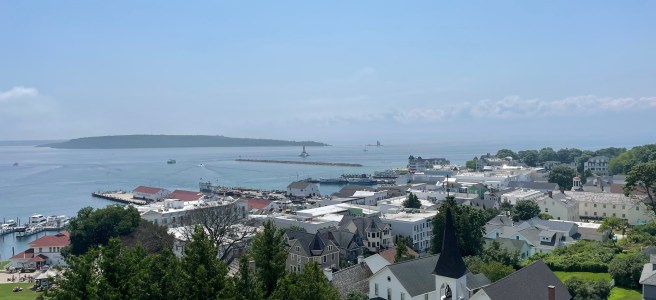
My family and I decided we wanted a beach to visit for our family vacation this summer, and we chose to take the road trip to St. Ignace, Mich., and the beaches of Lakes Huron and Michigan. We also took the ferry across the lake from St. Ignace to Mackinac Island.

Mackinac Island (pronounced Mack-i-naw) offers a unique opportunity to visit a place that is steeped in history and fun. A vacation destination for more than a century, the Island provides the experience of a place with no motorized vehicles. All transportation on the island, except for emergency services, takes place via horse or bicycle.

Two ferry companies take passengers out to the Island from St. Ignace on one side of the Mackinac Bridge and from Mackinaw City on the other side of the Bridge, Shepler’s and Star Line. Our hotel in St. Ignace, Cedar Hill Lodge, offered discounted tickets and shuttle service to Shepler’s, so that’s the ferry we went with. Both companies offer the same services at reasonable prices.

When we arrived, we made our way from the Shepler’s dock down the main street to the Mackinac Island Carriage Tour company, across from the Star Line dock. We wanted to see everything, and the tours are a great place to start, especially if you have some kind of mobility issue. Our driver, Kiki, introduced us all to our horses, Mona and Judy, to start the tour, and provided commentary as she took us on the first leg of the tour from down town, down the historic second street where the original fur traders’ homes can still be seen and visited, and out past the Grand Hotel to the stables and butterfly conservatory. From there, we took the second leg of the tour, behind a team of three hours and a new driver, through the State Park, to Arch Rock and Fort Mackinac.

My six-year-olds loved riding behind the horses, went into raptures over the butterfly conservatory, and ran all over grounds of the fort, which offers daily demonstrations of military life in the 19th century as well as a tea room, children’s play space, and living museum. Its history is connected with Fort Michilimackinac, which originally existed on the mainland in Mackinaw City and now has been largely reconstructed in its original location there. We were all fascinated by the living history the forts represented.

On the island, we walked down the bluff from the Fort to the main street again after lunch in the tea room, and browsed the shops, buying ice cream and fudge to take home. We watched fudgemakers in the windows along main street, dodged bicycles, and took a ferry back to St. Ignace late in the afternoon.

The next day, we drove over the five-mile Mackinac Bridge to visit Mackinaw City and Fort Michilimackinac, and there, we enjoyed leaning about the fort through the costumed presenters, and about its archaeology from the working archaeologists on site. They’re currently digging the site of a fur trader’s home, and they have been for about nine years. The on-site archaeologist said they’ll keep digging until they find nothing else to pull out of the soil, and that the cellars appeared to be used as storage facilities, so there’s lots to find.

As a side note, it’s possible to buy tickets to both forts at one time; I wasn’t sure we were going to make it to the mainland fort so I only purchased Fort Mackinac tickets the day we were there. However, when we did get the opportunity to go to the mainland fort the next day, we were able to pay only the difference between the two kinds of tickets at Michilimackinac, which saved us some money.

Fort Michililmackinac also has a large playground and access to a beach on the Lake Michigan side of the strait, and our girls were able to run off some energy before rain threatened. We headed back across the bridge to find pasties for lunch. We ended up at a St. Ignace staple: Lehto’s Pasties. This storefront has been around for more than fifty years, and it offers outdoor seating. The pasties are twelve ounces, pastry stuffed with steak, potatoes, onion, and rutabaga in a hand pie that’s perfect for lunch. We got three for the four of us, plus beverages, and headed down to the American Legion beach in St. Ignace to eat and collect rocks .

We thoroughly enjoyed our stay, and our only regret is we couldn’t stay longer.

If you go: Make sure to check out everything you’d like to see in advance and budget accordingly. While nothing was unreasonably priced, everything did cost something. The ferry and the carriage tour were the most expensive parts of the trip, but they were utterly worth it. Also, pay attention to COVID restrictions; we masked up at indoor spaces for safety’s sake.

On Considering Race and Laura Ingalls Wilder

I’ve been thinking deeply about race as it relates to Laura Ingalls Wilder and her works, lately, and I’ve made some observations that I’d like to share.

For those who don’t know, Wilder wrote the wildly popular Little House series of children’s books upon which the television show, Little House on the Prairie, was based. Recently, PBS aired a new documentary biography about Wilder, and I was pleased to see that it paid attention to the controversy surrounding the books, which have episodes of racism. In fact, the argument could be made that the entire series is racist, though it’s most evident and apparent in Little House on the Prairie, the book that tells the story of the Ingalls’ squatting on land in the Osage Diminished Reserve in Kansas and their subsequent departure from it.

However, the rest of the series isn’t exempt; negative references to Native Americans as well as the story of a performance in blackface by characters in the books also highlight the problematic nature of the works, which led to the American Library Association removing Wilder’s name from one of its major awards in 2018.

As an historian, I have said, and I will continue to say, that I think it’s important that the books continue to be studied and discussed, despite their flaws, and the discussion does need to be more encompassing than race. These books remain one of the few series that provides historians and others a feminine perspective on the pioneers’ movement West in the nineteenth century. Wilder gives women and girls in that story voice, and suppressing her work would also wrongly suppress that voice.

The challenge, of course, is that many want to suppress the painful truths of history. As someone put it to me recently, “Why can’t we just ‘get over it’?” My answer then, as now, is that we can’t just “get over” trauma, either personal or collective. The collective trauma of Native Americans being driven away from their homes and forced in many cases to suppress their cultural identities by white authority isn’t something the people are going to get over. The collective trauma of being dehumanized, thought “other,” enslaved, and demonized in popular culture isn’t something any Black person is likely to get over.

These peoples still deal with the remnants and ripple effects of these traumas every day.

When PBS aired the Wilder special, I Tweeted as I watched. At one point, someone on air said the books provided “emotional comfort food.” I retweeted the statement because that’s what the books are for me, too: emotional comfort food that reminded me as a girl that I had value and that my story and my voice meant something. Yet, not all responded positively to my retweet. One clearly said, “Not for me.” And that’s not only valid, it’s worth broader discussion.

My last observation is this: As a girl, I never noticed the books had racist overtones, and that is, in part, because I was a regular and avid watcher of the Little House on the Prairie television series, which expanded on the fictional Laura’s story. In that series, a number of respected African-American characters dealt with a variety of issues on race; the disability of Mary Ingalls was highlighted, and the show paid special attention to inclusion and diversity. I think my perceptions of how the books treated race was softened by simultaneous viewing of the television show.

We have a long ways to go in these discussions. I think it’s more than OK for those of us to have enjoyed Laura Ingalls Wilder’s works as “emotional comfort food” to continue to do so. But we need to remember, too, that her works aren’t inclusive, and for some, could be outright damaging. Don’t expect anyone to “get over it.”

See me discussing Laura: https://youtu.be/va03L58fA28

On Spooky Stories

When I was a young girl attending one of the many camps I enjoyed, I loved sitting around a campfire telling stories. One of my favorites is a mildly spooky tale that I can’t quite remember the origins of, though I suspect it came from a Girl Scout leader or text at some point.

Half of the fun of telling spooky stories is the ambiance. When telling stories around a campfire, the circle can be big or small, but the warm light from the fire casts deep shadows, as only faces are lit up. Woods or fields surrounding the fire seem darker, and deeper. As a storyteller begins to share a tale, everyone hushes, and the quiet is only broken by the breaking of a log, the snap of pine pitch crackling in the flames, or the call of a night bird.

Perhaps it is a night Iike this where you might hear me tell this story:

Once there was a couple from the Twin Cities named Jane and Martin Hill. They were newlyweds, and in the time-honored tradition of the Midwest, decided to take a road trip for their honeymoon, heading up North along back roads they’d never been on before, just for the adventure of it. One evening, they were driving as dusk was falling, and it started to rain.

It came down in great sheets, making it hard for Martin, who was at the wheel, to see the road, which had gone slippery. He slowed the car, but a shadow ran in front of it without warning, and he swerved. The car flew into a series of rolls, ending up in the ditch with the headlights pointing skyward.

Martin must have fallen unconscious for a moment, but when he came to, he noticed his wife was gravely injured. The rain had lightened up a bit, and there was just enough light from the dashboard that he could see she was bleeding.

Now this was in the days before cell phones, so Martin had no way of contacting an ambulance, and he, himself, knew very little about first aid. He was frantic, trying to think what to do. He managed to get himself out of the car, then to her side, which was crumbled. Something gave him tremendous strength, and he was able to pull her caved-in door open, and take her into his arms. All he could think to do was to get to the road and start walking toward the last town, which they’d passed several miles ago. 

He gathered Jane up, stumbled up the wet, slippery ditch, and made it to the road. He began walking, holding on to his wife and looking for any sign of assistance. His patience was rewarded after a time, and he spotted a light off the road, in the distance.

Martin looked for some kind of path or road that would take him to that light. In the dim light of the rising moon, he saw what looked like a footpath in the underbrush, and he took it, stumbling his way down the path, holding Jane carefully, and looking ahead to a large house that appeared, seemingly out of nowhere, with light emanating from its bay windows. He carried Jane up the steps to the front door, and used his foot to kick it harshly.

He heard footsteps from within, and the door opened with a creak. An old, decrepit man appeared, his long gray hair thinning over his scalp, and his walk marked by a heavy limp.

“Yes?” The man looked Martin and Jane over carefully.

“Please, do you have a phone? My wife, and I, well, we’ve been in an accident and she needs help. Please?”

The man pursed his lips, then nodded. “The Master is in.” He gestured. “Bring her inside.”

Martin entered the house, still holding onto his wife as the other man closed the door behind him and guided him into an old-fashioned looking parlor, gesturing to the settee. “Lay her there,” the man said. “I’ll get the Master.”

Martin lay his wife down. She looked pale and bloody, and he worried it was too late to help her. 

The man came back, and with him, he brought a tall, elegant-looking man in what seemed to be an old-fashioned suit, whom Martin thought was likely this “Master” of which the former had spoken. “Please,” Martin said. “Can you help me?”

“We haven’t a phone,” the Master said. “But I am a physician, of sorts. Let me see what I can do.” 

Martin stepped back, and the Master rolled up his sleeves as he knelt next to Jane. He checked her breathing, listened to her heart, and sat back heavily. “I’m sorry to tell you this, sir, but your wife is already dead.”

Martin felt faint.

“She can’t be! She can’t!”

“There’s nothing more we can do for her.”

Tears fell from Martin’s eyes, and for the first time, he noticed blood dripping down his own arm to the floor below. “Oh,” he said faintly, and fell, before the Master or his servant could catch him.

The Master checked Martin’s pulse, and shook his head. “He’s gone, too.”

“Master, what shall we do with them?” The servant asked.

“Lay him out on the other settee,” The Master directed, going to his parlor organ. He sat at the instrument as his servant laid out Martin on the other settee, and began to play a few chords.

“Master?” The servant asked.

“Just watch, Igor.” The Master began to play, deep rolling chords in flats and trills, a music none had ever heard before that night, and none would ever hear again. As he played, the bodies on the settees began to shake and shiver. He continued to play, the music reaching a fever pitch as the bodies sat straight up, and their eyes opened.

“Master!” The servant called out.

“Yes, Igor, yes!” The Master cried, then sang: “The Hills are alive, with the sound of music.”

A beat. A pause to let the truly terrible pun sink in.

Perhaps the Hills left.

Perhaps they stayed. 

But the power of music saved their lives that night. And when this story is told around the campfire, the “boos” are truly fun for the storyteller. Which was often me, with my terrible sense of humor.

Listen to me tell the story:

on-spooky-stories.mp3

Continue reading “On Spooky Stories”

Laura Ingalls Wilder and Me: My day on Rocky Ridge Farm

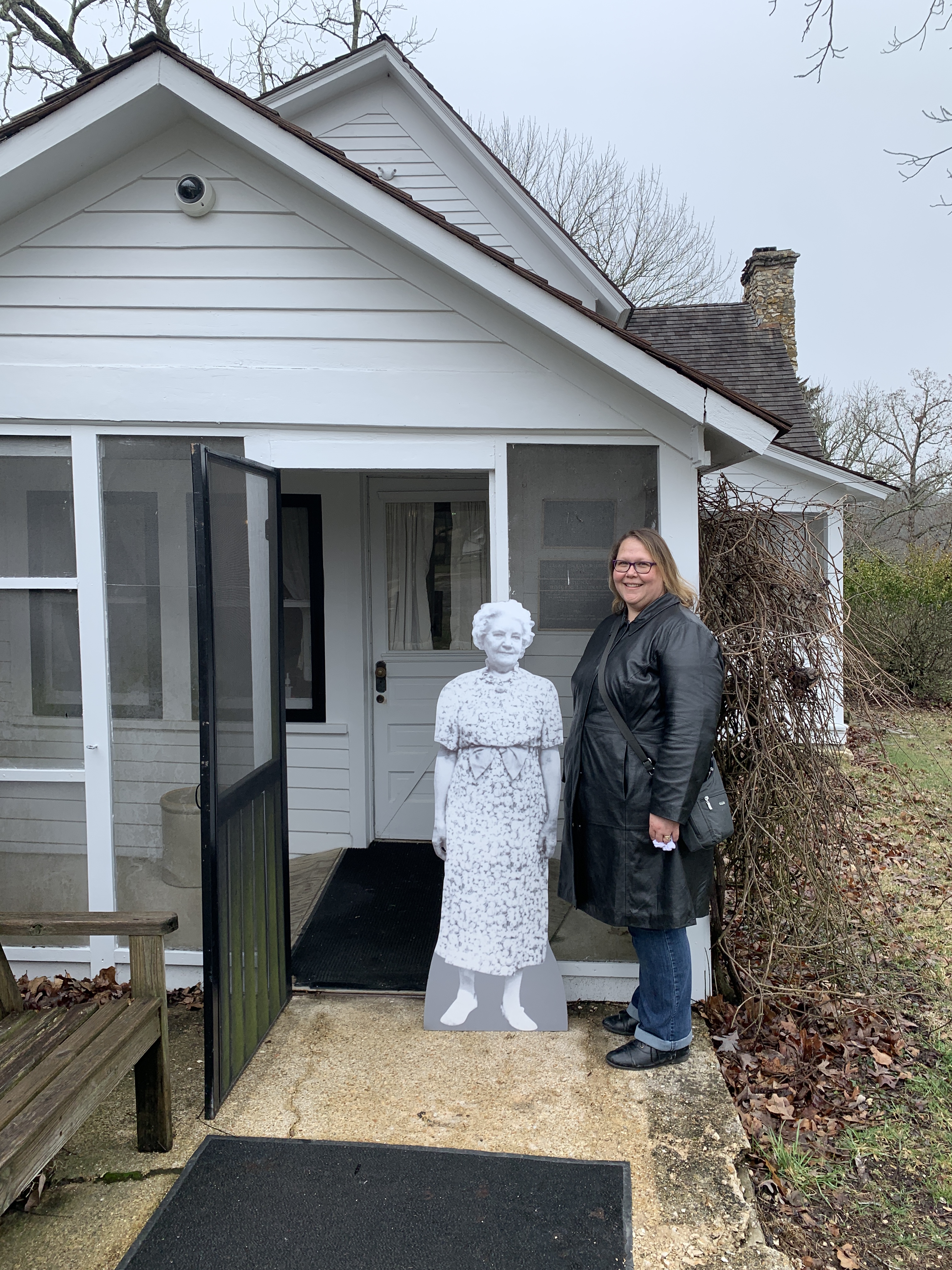
I’m standing here, next to a life-sized cut out of Laura Ingalls Wilder, in front of her side porch and the door that leads to her farmhouse kitchen on Rocky Ridge Farm, now known as the Laura Ingalls Wilder Historic Home and Museum.

Visiting Rocky Ridge has been on my personal to-do list since I first found out that she’d lived on this section of Ozark land for more than 60 years. Wilder traveled extensively as a child across the Midwest as her family looked for a place to settle down and prosper, and each of the places they stopped and lived has become part of the “tour” of Wilder sites. With this stop at Rocky Ridge today, I’ve been to every site but the one in upstate New York featured in Farmer Boy.

It’s hard, sometimes, to process the emotions that come from fulfilling a long-held dream. I brought my sister and my little girls along for this trip, and having them there added to my joy at finally walking on Wilder’s land, touring her house, and viewing her things, lovingly preserved as it was when she died on Feb. 10, 1957 at the age of 90. As our docent explained during our tour, Wilder’s daughter, Rose, locked the house three days after Wilder’s death, and it remained in stasis until three months later, when, with Rose’s permission and the formation of the non-profit society that currently maintains it, the home opened to the public for tours.

I’m grasping for words to express how it felt to stand in Laura’s kitchen, seeing the pipes that Almanzo had installed himself to bring their spring into the house so she’d have running water with which to cook. One counter held her flour sifter, a board, rolling pin, and ceramic bowl, looking for all the world that she’d stepped away for a moment from baking project. Her blue willow-patterned dishes, everyday favorites, gleam from an open cupboard. The green linoleum that tops the short counters–made by Almanzo to accommodate her petite size–is original.

Everything in the house remains as she left it in 1957. Through the kitchen to the dining room, visitors can spot Rose’s ladder stairs to her upstairs bedroom on their left. The dining room table, bought by Rose to furnish the Rock House in 1929, had been brought back to the main farm in 1936, when the couple moved back in after spending eight years in the Rock House that Rose had built for them. On a shelf built as a triangle to fit snugly in the corner above a heater, the clock that Almanzo traded a load of hay for during their first Christmas still tells the time, carefully wound every morning by the docents in charge for the day.

I found it hard not to touch things as I went through the house. (My preschoolers were very good at keeping their hands in their pockets. They started teasing me about doing the same, and made me giggle.) But it was hard! Most tables and dressers held a lace doilies, knitted by Laura in a favored “pineapple” pattern. Her sewing box sat under a table, ready for use; her nightgown lay across her bed. Her desk held letters from publishers and others; her parlor window seat held three pillows, one of which was embroidered by Angeline Day Wilder, Almanzo’s mother.

Laura’s library, Almanzo’s canes, Rose’s organ, and most of all, their space, lovingly built, kept, and maintained, echoed with the remembrances of their lives, lived.

The home is the showpiece that Laura intended, made from materials taken right off the farm, and emerging into view from the road at the perfect spot coming out from town. It’s a lovely home, and I can easily see why she didn’t want to be parted from it for long.

The museum by Rocky Ridge, now down from the house in its own space with its own parking lot, continued the collection of things that once belonged to many of the people in the Little House. Pa’s fiddle, once owned by Charles Ingalls, has pride of place in the gallery. But we can also see Caroline (Ma) Ingalls’ mother-of-pearl handled pen, Mary’s Braille slate, and Rose’s writing desk. I had to send my little girls, who had been very patient but were getting restless, with my sister into the attached store early so I could be sure to view it all: every. single. thing.

Of course, I spent way too much money in the gift shop. But I also signed stock; they had several copies of my first book, The Rediscovered Writings of Rose Wilder Lane, Literary Journalist. I also spotted it in the Rock House in a display about Rose, which I found flattering.

We had a very late lunch in town, then took pictures in Mansfield’s town square and visited the Wilder and Lane graves in the cemetery. I could have spent days, but one day was enough to view absolutely everything.

I highly recommend a stop if you’re in the area. My little girls, at 4 and 5, found it to be a fun experience. Walking the trails around the farm gave them plenty of exercise; somehow, and I realize how silly this is, I hadn’t realized that a farm in the mountains would be on such a significant incline. We were prepared with good shoes, so it didn’t trip us up. If mobility is an issue for you, don’t worry; handicapped parking is available at the museum, the main farm house, and the Rock House. We chose, mostly, to walk. We avoided the over-the-hill walking trail between the Rock House and the farm house, but otherwise walked everywhere.

I sent my mother a selfie of my sister, my little girls, and me, all smiling, pink-cheeked, from Laura’s front porch. She texted back, “Cool! Do you feel different?”

I gotta say, “Kinda, yeah.”

Decisions: A database is built

Today, we made a decision about what to do with the contents of the box.

Heather at Documentary Site and I have been discussing, all though the beginning stages of this project, the kinds of things we could do with the materials in the box. As I noted last week, straightforward historical interpretation is one way we could go. But as we look through all the materials, and we read the notebooks, we both came to separate, but similar, conclusions.

It’s best that we create something that others can use to make sense of this story, ask questions about this period and time, and interpret from their own perspectives what it is they see.

Therefore, we’ve started a database.

This work is going to take some time. In the boxes’ journals, we have at least 7,000 entries for a database that we will make searchable by theme or keyword for others to use. We’ve decided to set up a domain exclusively for this project, and create an online archive. Some of the story will be interpreted through narrative text that will go along with a theme. But all of the entries will be made available for an audience to use to draw their own conclusions.

Posts about the box itself may dwindle during the time that we’re using for database entry. We’ve set up a shared spreadsheet, and we’ve each picked up a notebook. We’ll enter information by notebook, date of entry, the full text of the entry, and a series of tags we think best reflects the content of the entry. For example, on early entry on weather and cleaning chicken coops might be tagged “weather” and “chores.” We’ll try to make it as accessible as possible.

It also occurred to me during this discussion that I actually have a lot more material than what’s in the box for a database of this type. When I wrote More than a Farmer’s Wife, I interviewed or corresponded with more than 200 farm women who were born on or raised on farms between 1910 and 1960, and I kept it all. I actually couldn’t bear to part with it, because I could only use it for broad context and triangulation of data I gathered while reading farming and women’s magazines for the period in the book.

But the voices there, in the interviews and correspondence, need to be heard, in their own words.

We’ll be taking a hiatus from technical posts as we work on data entry, but I’ll still be posting about what we find along the way. I’m also taking suggestions for what our domain and/or project name could be. “What’s in the box?” is great for a start, but it doesn’t really describe the scope of what this project is becoming.

Off to the database.