From LaCrosse to Pepin on the Great River Road, and LauraPalooza too!

LauraPalooza is one of my favorite places to go. A convention wholly dedicated to amalgamating the world of Laura Ingalls Wilder fans, scholars, and researchers, the event is sponsored by the Laura Ingalls Wilder Legacy and Research Association and is held every two to three years.

This year, the gathering convened in the LaCrosse, Wis., area with an eye toward a visit to Pepin, Wis., on the last day. Pepin is closest to where Laura was born in a small cabin about seven miles northeast of the town, which is located on the banks of Lake Pepin, an exceptionally wide spot of the Mississippi River.

I wasn’t able to attend all of this year’s convention, but I arrived Tuesday afternoon in time to hear the last few presentations, including a Q and A with Wilder expert William Anderson. Wednesday morning offered presentations about the psychology of the mother-daughter relationship, the “missing” Grace Ingalls,  and an entertaining presentation about the route taken by Laura and Almanzo from De Smet, S.D., to Mansfield, Mo., in 1894.

The afternoon, however, was taken up with the trip to Pepin.

I drove myself, and headed straight up the Great River Road to do so. The route, 75 miles from LaCrosse to Pepin on Highway 35, takes drivers through numerous small towns that sprung up along the Mississippi River during its heyday as the main means of travel in the area. The Mississippi still welcomes boat traffic, and in fact, it’s an active thoroughfare. The views along the way are spectacular, and each little town does its best to help travelers on their way.

I stopped in Nelson at the Nelson Cheese Factory on the way (on the recommendation of LIWLRA Homesite Representative Lynn Urban) and enjoyed a white chocolate raspberry ice cream cone. It’s a cozy place that also offers a variety of lunch items, coffee, wine, and assorted other products that make it an ideal place to get a snack and stretch my legs.

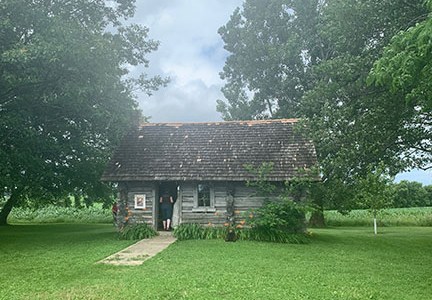
I then made my way through Pepin to the Laura Ingalls Wilder Birthplace Wayside.

I’ve been there several times, first in 1990 as a fresh-eyed 18-year-old on her first road trip without parents. That was nearly exactly 29 years ago. The little cabin that marks the site has been replaced once since then, and its sturdy construction, nestled in among the trees that have really grown in the last thirty years, made it look cozy.

LIWLRA and local host volunteers Susan Goettl and Julie Miller dressed the part for the event, staffing the cabin in their calico dresses and bonnets, and they dressed the cabin as well. Normally, it’s open to visitors but left empty to keep things from walking off. As a treat on Wednesday, however, Miller and Goettl had dressed the cabin, as well, making it appear as cozy as it might have in Laura’s day.

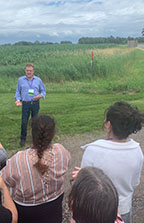
One special treat came from Anderson, who came along on the tour.
bill
Bill Anderson points out the general area where the original cabin was located.

He pointed out the general area that the original cabin had once stood, several feet southwest of the replica in a spot roughly near the wayside driveway’s entrance. A little rain kept umbrellas up, but it didn’t dampen the enthusiasm the crowd had for learning something new about Laura.

That stop kicked off the afternoon, which also featured a visit to the Museum in town, which had Wilder exhibits and merchandise. I also drove down toward the lake, up to the town park named after Wilder, and out to the farmer’s stand on the corner of the GRR and County CC, which takes visitors out to to the homesite.

Also scheduled were guided visits of the Oakwood Cemetery, where several significant people are buried, a supper, and a dance to mimic the Dance at Grandpa’s featured in Laura’s book, Little House in the Big Woods. Knowing I had to drive all the way home, however, meant I had to leave earlier than anticipated. I missed the dance, but I heard that it was a good time.

The Great River Road is always open for traveling, and a fun, leisurely drive to take. It’s not necessary to pair it with a trip to Pepin, but it’s always interesting to make that stop.

And as for LauraPalooza? The next convention will be near Malone, New York, birthplace of Almanzo Wilder, in summer, 2022. I’m already saving up.

Just Two Weeks to LauraPalooza

So I’m pretty late in getting my registration in, but I’m excited to be heading to LauraPalooza in two weeks. While I won’t be able to go for the entire three-day conference, I’m really looking forward to the day that I’ll be there.

The program shows a set of research presentations that focus on Rose Wilder Lane and on On the Way Home, and a bus trip to Pepin with special programming. I look forward to seeing some of my Laura friends, too.

That entire week will include not only LauraPalooza, but a road trip to Walnut Grove over the weekend to attend the Little House television show cast reunion. Guests will include two of my favorite people, Alison Arngrim and Dean Butler, as well as several original cast members. One, Radames Pera, also played the young Kwai Chang Caine in Kung Fu, and my husband (a martial artist) is excited to get his autograph.

I know several other Laura friends who plan to make the whole week one long Laura trip. And as Alison recently said on Twitter, it will be “amazeballs!”

Keep an eye on this space to hear more about it when it happens.

The Impulse to Preserve

I was talking with a friend this morning about my research into American farm women’s history, research that became a dissertation that became a book.

As part of that work, I interviewed and corresponded with several hundred women who lived on or worked on farms between 1910 and 1960.

One of the findings that emerged didn’t actually make it into the final book, because it was interesting, but not part of the original research questions. And that is the impulse to preserve their own histories that permeated so much of the information shared with me.

Numerous memoirs, hand-typed, or self-published, came to my desk. Whole boxes of family journals and memoirs (which I have kept, unable to part with memories) came to me with the line, “I hope you can use this. We have no use for it but are glad someone might.” Some elderly women in care centers talked to me with tears in their eyes, voices soft as they related stories from their childhoods, and talked to me of “Mother.”

One of the connections I made in my talk this morning made me think about this work within the context of my Laura Ingalls Wilder research.

Wilder’s personal story, when told, often starts with the idea that as a “retired” farm woman, she decided to write out the memories of her childhood so that they wouldn’t be lost. While this is ostensibly true, it’s also a carefully crafted myth spun by her publishers and daughter, Rose Wilder Lane, to lend mystique and pathos to the elderly woman sharing her stories.

Wilder, in fact, wrote for publication for years before her “retirement,” and Lane acted as guide and mentor in many ways to her mother, shepherding her career. The work of her writing is disguised by the myth that developed around her.

However, the myth itself seemed to inspire something fascinating: the impulse to preserve the memories before they’re lost.

Numerous volumes of memoir rest in my office. Some I drew on as I wrote the first book. But upon reflection, I think there’s another work here, something that ties into the reflection of memory, nostalgia, and a search for a past that seemed somehow better.

And yet, too, many of the women I spoke to were clear about the hazards of being a woman on the farm, as well as the joys. Lack of adequate medical care, schooling, and public transportation topped that list, along with the sheer volume of work ascribed to women only.

I’m not clear on where this work will go, yet, and I’ll need to go and re-read my own works to find the right direction. But I want to encourage those who have written their own histories and families’ histories down. An historian is always looking for your work. Everyday history needs to be preserved, and it’s often challenging to find those original resources.

(And yes, that includes preserving letters.)

This Long Winter makes me think of Laura’s

The mantra of Laura Ingalls Wilder in her book The Long Winter has been rolling through my mind often lately. Paraphrasing, she said, the end of January was near; February was a short month; and March would be spring.

Please, God, let March be spring.

I’ve written before about my own mental health struggles, which have arisen again this winter with a vengeance, and the slow pace of January (which seemed to last for at least a year), with its myriad snow storms, blizzards, and bone-chilling cold, hasn’t helped at all.

Schools were closed. Even my campus was closed for two bitterly cold days to all employees except those deemed weather-essential. We had regular temperatures in the negative thirties, with wind chills that took that already-inconceivable number down to the negative sixties.

Antarctica, anyone? Nope. Just Minnesota.

We had yet another blizzard on Sunday-into-Monday, and the howling winds that scoured our snug townhome were loud, and frightening.

In another chapter of The Long Winter, Charles Ingalls, finally breaking under the strain of the wind, yells, “Blast you, howl!”

Well, I did a little shouting, myself. My youngest children and I decided to yell back at the wind because it was being too loud. We giggled our way through the howling, and they slept soundly, afterwards.

The thing is, we can’t guarantee that March will be spring. In that horribly long winter of 1880-1881 that Wilder documents in her book, spring didn’t truly arrive until May, with a late blizzard or two making even April difficult.

But Wilder also was a careful to point out, in her optimism, that spring would eventually come. It was a certainty. And all we have to do, when the long winter makes us feel bleak, is remember that spring will come.

Meanwhile, I’ve been checking out beachfront properties on Zillow. In the south.

October snow

We in Minnesota woke up Sunday to snow.

I’ll admit to having a complicated relationship with the stuff. Last winter, in the immediate aftermath of our first major snowstorm in January, I broke my leg treading through the drifts. It didn’t heal until the last storm of the winter in late April.

I spent most of the summer wearing Birkenstock sandals, for the back support that comes from the solid cork sole. At a recent conference, friends who live in the American South teased me about wearing sandals in 50-degree weather.

I told them I’d wear the sandals until snow fell.

Well, snow fell.

It also melted right away, so I’m still wearing my sandals this week.

October is early for snow in Minnesota, and it’s rare for us to see flakes even as late as Halloween. It reminded me of Laura Ingalls Wilder’s story of the October Blizzard that kicked off the hard winter of her childhood, 1880-1881, captured in her book, The Long Winter.

The story, set in De Smet, S.D., recounts a winter packed with blizzard after blizzard. Trains couldn’t get through to the new frontier town, and by spring, many of the town’s occupants were starving, grinding seed wheat from their stores to make bread.

Dr. Barb Mayes Boustead, a meteorologist, developed a weather index for her dissertation that focused on that winter. She found, through its application, that Wilder’s depiction of the weather that winter was accurate. The index itself has interesting implications and applications for historians interested in how weather is talked about and how it actually was in history.

Boustead’s blog, Wilder Weather, devotes itself to weather and to Wilder, both, and it’s worth a read.

At the 2012 LauraPalooza, my mother and I spent a portion of our time showing attendees how to make and bake the Long Winter bread, made from ground wheat berries and sourdough starter. It’s actually pretty tasty, but I can’t imagine living off it for weeks.

I’m not particularly thrilled with the implications of October snow for this winter. But at least I found my boots. Just in case.

Baked Beans

My mother’s contribution to nearly every holiday feast we had growing up was her from-scratch baked beans.

Baked beans are a classic British dish, often served as breakfast with a full English (which also includes grilled tomatoes, fried eggs, and fried pork) or on toast. My father’s mother, Elsie, always ensured she’d have some of the leftover baked beans to take home, if possible, for her favorite beans-on-toast.

Today, it’s easy to buy baked beans in a can to heat and eat. Recipes for their use as a base also abound. However, the original recipe can’t be topped by something out of a can.

This classic features heavily in the Little House series, in which Laura Ingalls Wilder describes her mother’s procedure for making baked beans and bean soup as staples of winter eating. It was years before I connected those stories with my mother’s recipe and my own enjoyment of baked beans. Another recipe for them can be found in Barbara Walker’s excellent Little House Cookbook.

This recipe, however, comes directly from my mother, who notes that the “bean pot” — a covered crock–is key to the success of the dish. She also notes that her sister, my aunt Julie, often skips the first step and uses plain, rinsed-and-drained, canned navy beans as her starter to cut down on prep time.

Linnea’s Baked Beans

Soak overnight:

1 lb. navy beans.

In the morning, drain the beans, cover again with fresh water and ¾ t. baking soda, and bring just to a simmer. Skim off foam as beans cook. They’re ready when you can spoon up a few and blow on them and the skins crack. Drain again, and add beans to the bean pot.

Add:

½ c. brown sugar

1 sm. onion, chopped

¼ to ⅓ c. molasses

½ lb. bacon, chopped

½ t. black pepper

⅓ t. dry mustard

1 T. salt

Add just enough water to cover the beans. Bake at 300 degrees for at least four hours.

Looking ahead to LauraPalooza 2019: Pepin-bound

The Laura Ingalls Wilder Legacy and Research Association this week announced the location of its 2019 conference, and it’s in Onalaska, Wis., just south of Wilder’s birthplace of Pepin, Wis.

The full announcement also reminds those interested about the big Little House on the Prairie cast reunion in Walnut Grove the week following LauraPalooza in July.

I was involved in the founding of the organization and in the running of the first two conferences, which we held in Mankato in 2010 and 2012. Personal circumstances kept me away from the 2015 conference in South Dakota and the 2017 conference in Missouri, but I’ve been excited to see the line-up of speakers and workshops as they appeared.

The conference was deliberately conceived as a site for Wilder fans, scholars, and independent researchers to meet and share across the usual divides that occur between such different groups. What’s fun about LauraPalooza is that everyone can enjoy interesting, well-researched presentations right alongside fun activities taken from the books, such as ice cream socials, cooking demonstrations, and handwork.

With the next site being close to Pepin, it’s in easy travel distance for me. Pepin is actually the first Little House site I ever visited, the week after I turned 18 in 1990. My friend, Maria, and I tossed a tent and sleeping bags into the back of my 1980 Ford Granada and headed west from Chippewa Falls, Wis., to seek out Little House sites just because we were legal adults and we could.

We took back roads into Pepin and got lost.

Eventually, we found our way, and I still remember the excitement in my belly when we drove up to the little replica cabin on Laura’s birth site. I think I probably squealed. (Maria and I are still in touch; I wonder if she remembers?)

After that first stop, we found our way into Pepin proper to visit the little museum there, then camped in Stockholm, Wis., our first night. The next day, we headed west toward Walnut Grove.

We locked our keys in the car in Faribault, Minn. Fortunately, there was an Auto Zone nearby and we’d left a window open slightly, so that was a free, less-than-fifteen minute fix with a wire coat hanger.

We eventually made it to Walnut Grove, squealing over the museum there (which at that time extended across the road in a series of trailer-type things. It’s been enlarged, renovated, and refurbished since, and is one of my favorite places to stop). We didn’t manage to find Plum Creek on that trip. In fact, my brakes started grinding as we pulled out of Walnut Grove and headed back east.

We camped at Fort Ridgely State Park that night, and wandered our way up to St. Croix Falls, Wis. the following night, before heading back to Chippewa Falls and new brakes.

At LauraPalooza 2010, twenty years later, I waded in Plum Creek for the first time. It’s another one of my favorite memories. I think there’s a picture of me, along with several other Laura enthusiasts, wading in the creek that summer.

I’m excited for 2019. My last published work in the area of Wilder research appeared in the South Dakota Historical Society Press’s work, Pioneer Girl Perspectives, in 2017. My contribution was a chapter about Rose Wilder Lane and her career as a working writer, touching on her FBI file and her work for Woman’s Day magazine.

I haven’t really dug into anything new lately, but I have been thinking about what viewing the Little House books through a cultural lens over time might look like. Why do the books remain popular? I have some ideas about that that I might propose to share in 2019.

Meanwhile, I look forward to seeing the Pepin cabin again. Maybe I can talk Maria into joining me for the almost-thirty year flashback photo.