The Holiday Pot-Luck

Today, my department hosts its now-annual potluck to kick off December’s rush of finals, graduation, grading, and paperwork.

As a tradition, the potluck apparently got its name from Thomas Nash, who discussed added guests in terms of whatever’s available to feed them–the luck of the pot. However, it’s evolved to be a communal meal to which guests all contribute in one form or another. Laura Ingalls Wilder writes about a communal Thanksgiving dinner held in DeSmet, S.D., one year, sponsored by her church, where the members of the Ladies Association brought different dishes to share for a fee.

My first exposures to potlucks? Well, I can’t even remember. It seems they’ve always been a thing, though I do most closely associate them with the church ladies of my childhood, frankly. But every meal as an extended family functioned similarly; no one person provided all the food for any particular meal. All took part.

Thanksgiving became a perfect showcase for the potluck and for family dishes. Though snow prevented us from traveling this year, we were ready with our contributions of pie and cupcakes. My sister, brother, mother, and I texted back and forth for a few weeks to determine the final shakedown of who would bring what to ensure everything was covered.

The office potluck is a bit different. No one knows exactly what everyone’s bringing, just that everyone should bring something. To that end, I’ve evolved into the potluck person who brings some sort of hot dish to share that’s heavy on protein. There’s never, ever, enough protein at a potluck, especially at a holiday where sweet treats are the norm.

This time around I made meatballs from scratch, which, as I write this, smell amazing. the aroma brought all the participants to the front office to load up a plate. We’ve also got a variety of other treats at the table, and that’s half the fun of a potluck. You never quite know what’s going to be on offer.

Amy’s Meatballs

Suitable for spaghetti, sandwiches, and plain-old snacking, meatballs are family staple. My general recipe is actually a rule-of-thumb kind of thing: One pound of ground meat to one cup of fresh bread crumb to one egg, plus seasoning.

The batch I made for today turned out really, really tasty. I used jarred tomato sauce for the coating and kept them hot in a crockpot.

3 lbs 80/20 ground beef, thawed

2 cups Italian-seasoned dried bread crumbs

1/3 cup milk

1 T. salt

1/3 cup grated Parmesan cheese

2 eggs

Blend the crumbs, cheese, and salt; add milk and stir together.  Let stand for a few minutes to “freshen” the crumbs. Crumble the ground beef over the top. Add the two eggs; mix with your hands until combined. Don’t knead too much or they’ll get rubbery.

Portion out into 1 1/2 inch balls on a baking sheet. Bake at 375 for 20 minutes.

Once out of the oven, you can sauce them any way you’d like. I added this batch to a crockpot with four cups (two jars) of spaghetti sauce. If you used plain bread crumbs and added allspice and celery seed to the main recipe, you could sauce with mushroom cream gravy for Swedish meatballs. As I said, it’s more of a rule-of-thumb than a true recipe.

Enjoy for your next potluck!
Lovely Thanksgiving Turkey

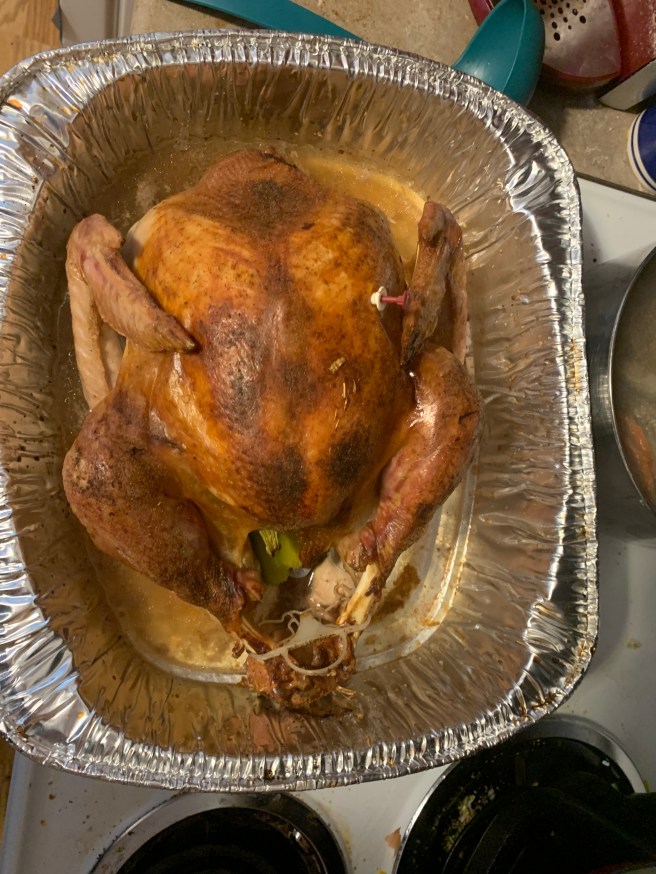
Take one thawed turkey, stuff with onion, bay leaf, and celery, season with salt and pepper, and set in a roasting pan, uncovered, to bake at 350 degrees for 15-20 minutes per pound. Golden perfection. When cooked through to correct temp, remove from oven, cover in foil and let stand for 30 minutes before carving. Utterly moist and delicious.

I also baste it with homemade turkey stock once every hour while it cooks. That’s a trick I learned from my sister-in-law, who simmers the neck and gizzards in water on the stove top for the duration of baking time to baste with. I do the same, but add onion, bay, celery, and carrots to the simmering stock, too.

Perfect every time!

Butternut Squash Soup

I impulsively bought an Instant Pot last week, and I tried it out Sunday by making Butternut Squash Soup.

Other than prep, with the pressure cooking setting on the Instant Pot, we had scratch-made soup in 20 minutes. I was impressed. And the soup was delicious.

To be clear, you can make this soup on your stove top. It will simply take much longer to soften your squash to the point that you can blitz it up into soup.

The preschoolers loved the soup. They ate it with fresh ciabatta bread from our local farmer’s market, and asked for more.

Butternut Squash Soup

One large butternut squash, about four pounds, peeled, seeded, and cut into one-inch chunks

4-6 cups chicken or vegetable stock, or equivalent

1 large shallot, peeled and diced

1-2 T. olive or canola oil

1/2 t. powdered ginger

1/2 t. mild curry powder (I used Penzey’s Maharajah curry powder)

salt and pepper to taste

On the stove: Sauté shallots in oil until tender; add enough butternut squash cubes to fit the bottom and let carmelize briefly. Add the rest of the cubes and stir. Cover with four cups of stock. Add the curry and ginger powders. Simmer until the squash is soft, 1 to 2 hours. Blend with an immersion blender. Thin with more stock (or milk). Serve.

In the Instant Pot: Use sauté setting to proceed as above, but after the stock is added, switch to pressure cooking on high for fifteen minutes. Vent with quick release when done. Blend, and thin if necessary with stock or milk. Serve.


Strawberry Cake

My youngest turned 4 over the weekend, and she requested a strawberry cake for her birthday.

This turned out to be a little more of a challenge than originally intended. Probably influenced by our viewings of the Great British Baking Show, she wanted a giant layer cake, frosted white and topped with fresh strawberries. The cake itself also needed to be strawberry flavored and pink.

Since we were taking the cake to a family birthday party at which some family members with food allergies would be present, I needed to make it from scratch, and I needed to ensure no corn, soy, or cottonseed oil products would be included in the baking. That meant no powdered sugar, which contains cornstarch to prevent caking. It also meant a deep dive into the world of strawberry cake to find a solution.

Most strawberry cake recipes include strawberry gelatin for flavoring and color. That was a no-go for this occasion. Some recipes included pureed strawberries, cooked down for flavoring–something I didn’t really want to do, given the temperature and the humidity on baking day. Two mentioned the concept of pulverizing freeze-dried strawberries, and that the texture of the finished cake was good and flavorful, if not as moist as the kind with the pureed strawberries.

In the end, I went with a vanilla cake recipe, substituting pulverized freeze-dried strawberries for part of the flour. I baked the batter in three eight-inch layers and left them to cool while I contemplated icing.

So, buttercream would be ideal, but it contained powdered sugar, making it off-limits.

I settled on Seven-Minute Frosting, using Paula Deen’s recipe from the Food Network website.

Seven-Minute Frosting is plain white sugar, egg whites, water, and cream of tartar beaten over boiling water for seven minutes to create a thick, glossy icing that holds its shape and acts like candy when it sets. The day I was making this cake, the humidity was ridiculous, so the icing didn’t set up well at all. I persevered, however. And in doing so, I made a rather tasty mistake.

As I stacked my layers of strawberry cake, I added a layer of icing and fresh sliced strawberries between each cake, forgetting that fresh strawberries and sugar together produce syrup. It got very sloppy for a bit. I spread the icing over the top, letting it drip down the sides, and my preschoolers “helped” put the fresh cut whole strawberries, cut side down, on the top. The icing kept melting down the sides with the humidity and the chemistry, so I set it, uncovered, in the refrigerator for what amounted to about eighteen hours.

I quietly scooped frosting and strawberries off the cake plate every so often all evening, spreading them back up over the sides of the cake.

The next day, the icing had set. The cake looked pretty. And when we started to serve it, lots of wonderful things became apparent. First, the icing layers crackled as I sliced through the cake, sounding like rich candy. They weren’t too dry to cut, but provided a delicious texture with the soft berries and the rich cake. The cake itself, far from being dry, had soaked up the strawberry syrup created by my mistake. As one guest said, it tasted like old-fashioned shortcake when it had been soaked in the juices of the strawberry syrup.

We ate it all up. And the birthday girl loved it.

If you try it, I used the vanilla cake recipe found here. I used an entire 0.8 oz bag of freeze dried strawberries, blending them until they resembled flour. I spooned the strawberry dust into a one-cup measure, then added enough all-purpose flour to the cup to fill it up, incorporating it into the flour quota for the recipe.


Baking for the Holidays

I’ve spent the last few days in a baking marathon, getting ready to gift treats to friends and families for the holidays.

Said marathon was accompanied by eight inches of snow and two enthusiastic preschool helpers, who had a great time playing with all sorts of cookies.

When I’m able, I like to make one new cookie each year, followed by an assortment of old favorites. This year, so far, I’ve made my comfort chocolate chip cookies with a mix of butterscotch and chocolate chips, stir-and-drop sugar cookies with a green glaze, lemon-sugar cookies with a lemon frosting, fudge, and assorted chocolate-covered pretzels.

I still need to make, per tradition, chocolate-covered peanut butter balls and gingerbread cookies.

I’ve been posting pictures of the treats as I make them on Facebook, just to tease my friends and family. It’s been fun. And I dropped off my first treat box today, to my department’s treat day. It’s the week before finals in the Department of Mass Media, and for a change, I’m not a part of the general wash of frantic activity.

I have, however, been busy.

I mentioned several weeks ago that I had serious writing goals for November.

I presented at a conference, and I managed to write more than 25,000 words on my original fiction. I also made it through literature review and preliminary research for the main paper I’m working on as part of my sabbatical, so I’m feeling pretty accomplished.

I’m also thinking about a draft abstract for LauraPalooza, the deadline for which is Wednesday of this week, so I’d better move on it if I plan to.

But as snow fell this weekend, my focus was entirely on my family, and my young taste-testers, who love to smell every ingredient before I put them in the mixing bowls.

Lemon was a “thumbs up” from my younger, but a “thumbs down” from my older little girl. Fudge was “thumbs up” for my older little girl, but a “thumbs down” from my youngest, despite her trying it twice. They have widely different tastes in some areas!

But both love getting to help. With supervision, they made a bunch of white-chocolate-covered pretzels, decorated with green M&Ms, and placed Rolo candies on other pretzels for the Rudolph treat.

I look forward to helping them learn to make the other treats as they grow.

Giving Thanks

We celebrate Thanksgiving this week. My refrigerator is packed with everything we need for a meal that showcases abundance, and I’m thrilled that all my kids will be home for the holiday. We have much to be thankful for.

I’ve got three bundles of collard greens ready to go. I have an enormous turkey ready for roasting. I’ve got bread dough, and carrots, and potatoes, and stuffing. I baked chocolate chip cookies over the weekend, and I have three pies in the freezer.

I think we’re set for food.

But what I look forward to the most is hanging out with the family. We have some games to play after dinner this year–the youngest girls are ready for Candyland and Chutes and Ladders–and since my son is in town, I think we’ll put up our Christmas tree, too.

Thanksgiving has always meant family to me. Up until my grandmother, Elsie, passed away in 2001, I spent every Thanksgiving in her kitchen, helping to produce the enormous feast we needed to feed the Mattson family. We used the community room in her apartment building, and we often had, at minimum, fifty people eating.

We’d go through two twenty-pound turkeys, cooked on Weber grills or in Grandma’s oven, along with numerous sides, including a sixteen-quart stockpot full of mashed potatoes. One of my earliest cooking memories, in fact, is peeling potatoes for that pot, alongside my cousin, Nicole.

(Leftover potatoes, if there were any, would become lefse. That’s another post, but we rarely had enough leftover potatoes to do a whole batch.)

As Elsie’s eyes deteriorated, she had to move to be closer to family, and the communal thanksgivings changed venues, some at my parents’ home. After she passed away, her sons’ families sort of passed it back and forth, but we’ve really outgrown one location for Thanksgiving.

Now, I host for my immediate family and their extended, local, biological family. We’ll FaceTime with my parents’ and the entire crew eating in Chippewa Falls. We all have so much family, that figuring out where everyone is going to eat, and when, and whether we’ll have time to visit others, is an ongoing debate.

But that’s something to be thankful for, too. We all have several places we could go to be loved, filled with thanks, and fed.

Peace to all of you this week.

Comfort Food for a Snowy Monday: Saucepan Brownies

I just got back from a great, but quick, trip to Tennessee to speak at the Symposium for the 19th Century Press about my mentor, Hazel Dicken-Garcia, who was an avid supporter of that annual event.

It was good to see old friends and reconnect. I came away with numerous ideas for upcoming research projects and more invitations for visits and trips and conferences.

I also came away a bit blue, so today, I’m posting my recipe for quick saucepan brownies.

This is another recipe that I no longer need to look up. When we want a quick, chocolate, treat, this can be whipped up in five minutes and in the oven. Within the hour, we can be savoring warm brownies, sometimes with frosting, sometimes not, but always delicious.

Preheat oven to 375 degrees. Grease an 8 by 8 baking pan.

Melt together:

1/3 cup baking cocoa

1 stick real butter

Remove from heat; let cool briefly. Add:

1 cup white sugar

2 eggs

1 tsp vanilla

Beat together with a big spoon until glossy, then stir in:

3/4 cup all-purpose flour

Until it’s mixed in well.

Pour into prepared baking ban and bake 30 minutes, or until it passes the toothpick test.

We often top with chocolate chips when it comes out of the oven, letting them melt and spreading the warm chocolate over the top before we cut into it. We’ve also topped them with scoops of virtually any flavor ice cream you can imagine. I think my favorite is raspberry sorbet.

Enjoy when you need quick comfort food on a snowy Monday.

Chocolate Chip Cookies: Comfort food for a hard week

Times are challenging, the news is triggering, and I’m not quite sure what I want to say about all of it. I learned long ago not to speak out rashly in anger, but to think carefully about what I want to say, especially about important and potentially combative topics.

That said. I’m still angry. So I’m still percolating.

While I’m percolating, I decided to share one of my comfort food recipes. I’ve made so many batches of Chocolate Chip Cookies that I no longer need to refer to the recipe. I am the family cookie baker, but my skills with this recipe were honed in my time as a nutritionist and cook’s assistant for the campus day care at the University of Wisconsin-Eau Claire. Four out of five days in the week, I prepared and served healthy, balanced snacks for the under-five set.

But on Fridays, I broke out the treats.

Chocolate Chip Cookies are a classic favorite. My original recipe was ripped right from the Nestle Chocolate Chip bag, but I’ve tweaked it a lot to produce a cookie that’s uniformly cooked, chewy instead of crunchy, and loaded with chocolate chips. Pay special attention to the method.

The recipe:

Preheat oven to 375 degrees.

Beat together until fluffy:

3/4 cup of white sugar

3/4 cup of brown sugar

1/2 cup of real butter

1/2 cup of butter-flavored shortening

Gently stir in:

2 eggs

1 teaspoon of vanilla

Blend in:

1 cup of all purpose flour

1 teaspoon baking soda

1 teaspoon salt

Fold in:

1 1/4 cups additional white flour

Fold in:

2 cups semi-sweet chocolate chips (Variation: mix up your chips–my husband particularly likes a mix of butterscotch and chocolate chips)

Using a one-ounce scoop (or a rounded teaspoon), drop cookies onto ungreased sheet pans. I bake two sheets at a time, swapping the trays’ placement in the oven half-way through baking. I usually start with 4:30 on the timer, then swap for another 4:30.

Your oven might be tricky, so watch for lightly browned bottoms and golden, dry tops of the cookies. If the tops are brown, you’ve baked them too long for the chewy stage. They’ll still be tasty, but they’ll be crunchy. Yield is about four dozen.

I made a double batch this week.

Making Fry Bread

As promised in the post about the Mahkato Wacipi, I’m discussing the Fry Bread that is a staple at many First Nation gatherings.

The recipe I use comes from a small cookbook I picked up at the Wacipi several years ago, and it offers a bit of back story for the recipe. Fry Bread is one of those recipes that evolved out of the American Indian experience interacting with the U.S. Government. White flour as we know it today was not a part of the original diets of most First Nation tribes.

Flour came into their diets with the distribution of food stuffs and commodities to tribal members living in poverty in the wake of numerous conflicts across the country. Fry Bread became a staple food, using the groceries made available.

I’ve seen several other recipes for Fry Bread, some claimed by different regions and tribes, but they all start with flour and dried milk powder.

This is the recipe I used to make Fry Bread as an after-school snack for my older children when they were teens, and I’ve also used it for small group demonstrations. I’m not an expert on indigenous foods, but this one is pretty tasty and well worth the effort.

Fry Bread

Heat oil for frying. You could use a deep-fat fryer at 375 degrees. I use my enamel-lined, cast-iron Dutch oven filled about half-way with canola oil, heated to about 375. You could use a candy thermometer to check the temp.

Measure out three cups of self-rising flour (or three cups white flour, 1 T. baking powder, 1 t salt, mixed together). Add one cup whole milk (or equivalent in dried milk powder and water). Mix together. Dough will be stiff. Knead briefly and let rest for at least five minutes, while oil is heating.

Turn out dough. Cut into 16 pieces. (I just cut dough into quarters, then in quarters again.) Roll each piece into a ball.

When ready to fry, pick up a dough ball and flatten it into a circle about a quarter to a half-inch thick. Drop into hot fat and fry until golden brown on both sides. Remove to a rack or towel to drain.

Best eaten hot. We like to sprinkle with cinnamon sugar or powdered sugar, to serve with honey. For a savory take, divide the dough into eight pieces instead of 16 before frying. Top these bigger pieces of bread with seasoned ground beef, lettuce and tomatoes to make what’s known as an “Indian Taco.”