On Family Foods and Ethnic Ties

I’ve been cooking and baking nonstop for the last week. I’ve gone through ten pounds of flour, four pounds of butter, and innumerable eggs. I’ve made dips, cookies, bread, meatballs and many other lovely things, and I’m not inclined to stop until the New Year.

Part of the reason for the kitchen flurry lies in the season. We celebrate Christmas, and many of our food traditions show up at this time of year. Ethnically, I’m British, German, Danish, and Swedish, primarily, and when I look at my holiday menu, I see the ripples of those traditions settle on my plate. I’ve always been the primary cookie baker at Christmas in the family, and I certainly made a dent in my usual list: butter cookies, Russian tea cakes, peanut butter bon-bons, and peanut butter kiss cookies all appeared on my table—and disappeared from it. I made garlic-artichoke dip and olive tapenade, and baked fresh French bread for those allergic to soy and corn in the family.

Most of these recipes are family favorites I picked up here and there over the course of a lifetime. The bon-bons? Middle school French class. Tea cakes? Middle-school home economics class. Peanut butter kiss? My cousin’s Grandma Elaine. Butter cookies? Who knows? But they’re a staple on all German and Scandinavian holiday tables.

The garlic-artichoke dip comes from an editor at my first professional newspaper job. She brought it hot and bubbling to each gathering, and it was luscious. I never got her recipe, so I’ve been playing with it ever since, trying to get it right. I think I’m close. The tapenade was a suggestion from my earliest viewings of the Food Network. I think it might have been a Cooking Live Primetime recipe.

But other foods clearly come through an ethnic heritage. For breakfast on Christmas Day, we have German potato sausage, made by my mother and her sister. For dinner on Christmas Eve, it’s always Swedish meatballs, thanks to my Grandpa Tom, a first-generation son of Swedish immigrants. On Christmas Day, dinner has always sort of rotated, but now that I host it at home, when I can afford it, we have a beef rib roast, a nod to my British ancestry.

If I have leftover mashed potatoes, I’ll probably make lefse. My Irish Grandma Elsie learned how to make it from her Scandinavian neighbors in northern Wisconsin, and she taught me how to make it.

Other traditions just creep in. I bought a snowflake waffle maker a few years ago; it was Frozen-themed. My girls were little and very into Elsa and Anna and Olaf. Now, apparently, I’m required to make snowflake waffles to go with our sausage on Christmas morning every year. (What will happen when the waffle maker gives out? A problem for another day, I guess.)

As I’m getting older, I find myself stopping to reflect more often on the heritage that stays with us, and the legacies our ancestors leave behind them. I’ll savor the next cookie and wonder: Which of my ancestors made this, too?

On Leftover Turkey Soup

Sometimes, I think my husband prefers the leftovers from Thanksgiving to the meal itself.

Sometimes, I don’t blame him.

My favorite post Thanksgiving meal is a slab of perfectly moist roast turkey breast on a fresh, buttered roll. There’s something about that combination that makes me utterly happy. This year, I made a fresh cranberry sauce for the first time, and that hint of tartness with the fresh turkey also made me utterly happy. In fact, we dipped fresh apple and pear slices into the warm sauce as an appetizer this year, and we generally agreed that we’ll have to try that again.

However, the day after Thanksgiving, the “leftover” meal of choice is turkey soup.

This starts by breaking down the leftover turkey carcass from the day before. At this point, the carcass should have been carved away, leaving bones with minimal meat attached. This year, I roasted a turkey breast rather than an entire bird, and it just fit into my 12-quart pot.

For this recipe, you will need:

1 leftover turkey carcass, carefully chilled after carving

Two to three cups of leftover veggie tray vegetables: carrots, celery, and green pepper slices are my favorites.

1 cup of diced yellow onion

Two bay leaves

Salt and pepper to taste

1 t. dried thyme (more or less to taste)

1/2 t. granulated garlic or equivalent fresh chopped garlic

Leftover roast turkey, 1-2 cups diced

Egg noodles or rice

Put the carcass in the stock pot, and cover with cold water. Set on the stove to bring to a boil over medium heat. Add your chopped veggies and seasonings. Cover, and bring to a boil. Once boiling, back the temperature down to low and simmer for at least two hours. At that point, remove the bones from the stock. Taste. Add two to three bullion cubes to boost the stock if necessary, and salt and pepper to taste. Dice any leftover turkey slices to add to the pot. Bring back to a boil, then add noodles or rice. Cook until the noodles or rice are done, then serve.

It usually yields enough to serve for a couple of meals. We serve one immediately, then I bag the rest in a one-gallon Ziplock freezer bag to transfer straight to the freezer for another meal later.

On Stir-and-Drop Sugar Cookies

My favorite sugar cookie is incredibly easy to make. It’s based on a recipe in the original Betty Crocker Cooky Book, and I remember my grandmother making them regularly when I was a child. One thing I like best about it is its reliance on good quality vegetable oil, rather than butter, as a source of fat.

It’s also easily adaptable. Swap out the extracts and stir in different flavorings to get different, and tasty, results. For the batch I made Sunday, I added a tablespoon of sprinkles to the batter to get a confetti look.

1. Set oven to 400 degrees.

2. Whip two eggs in a medium mixing bowl with a fork.

3. Using the same fork, beat in 2/3 cup good quality vegetable oil and 2 teaspoons of vanilla extract.

4. Beat in 3/4 cup granulated sugar.

5. In a separate bowl, mix 2 cups all-purpose flour with 2 teaspoons of baking powder and a 1/2 teaspoon of salt.

6. Stir dry ingredients into wet.

7. Drop by teaspoon onto a parchment-lined baking tray. Press flat, preferably with the bottom of a glass dipped in sugar.

8. Bake for 8-10 minutes, or until edges are a delicate brown.

On remembering at Thanksgiving

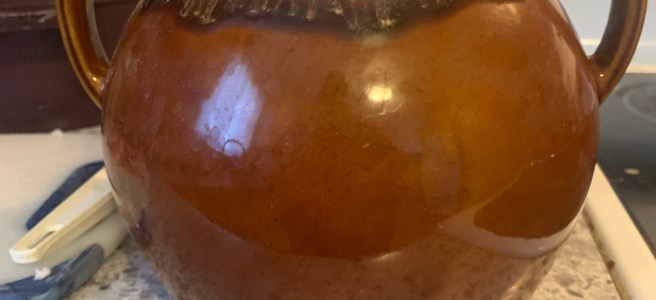
I don’t even know how old this pot is. It’s a roaster. Big enough for a 20 pound turkey. Big enough for a family feast of fried chicken at the Fourth of July. Big enough to feed crowd.

This one belonged to my grandma Elsie. My childhood surfaces every time I bring it out, memories of this very pan filled to the brim with whatever she was serving to the crowd in her kitchen when we visited. Thanksgiving was always at Grandma’s, even after she downsized, left the farm, moved into a trailer, and then to an apartment in town. Often, more than 50 of us—family and extended family alike—gathered in the community room in her building for Thanksgiving dinner.

We’d have at least two turkeys. The menu also reflected the whims of whomever was bringing sides. There was always mashed potatoes, and gravy, and stuffing. My mother’s baked beans, sometimes sweet corn, and sweet potatoes speckled with marshmallows sat at the table next to occasional treats brought by cousins who lived further afield than rural Wisconsin.

We ate. We gossiped. We played games of all kinds. We’d have a cribbage tournament sometimes. Other times we’d find the Macy’s parade on the little TV in the corner, followed by whatever football game was playing. (Bonus points for days when the Packers played the Lions.)

This year looks a little different. None of us are traveling, to keep us all safe. This pan is out in my kitchen, ready for the turkey, which I fully expect my small family will be eating for the next week. I have lots of little treats for us to nibble on over the course of the day, and the parade is already on. We’ll connect with other family members later today over the phone. And as we give thanks, we’ll remember we have food, we have shelter, and we have love.

Best wishes to all of you on this Thanksgiving.

On prepping for Thanksgiving at home

Today I started making things that we normally cook in the oven ahead of our Thanksgiving meal at home Thursday.

I started out by making my mom’s baked beans. They’re a dish that takes quite a lot of time, and a lot of oven time, and it just makes sense to make them ahead. We will probably sneak some to eat with our supper tonight. What you see in the picture above is my bean pot, the key to the whole dish. I am not sure why, but they just don’t turn out right if you cook them in anything else.

Each day this week, I will tackle one thing that takes oven time that I want to save for my turkey on Thursday. Tomorrow, it’s pie day. Wednesday, it’s bread day. On Thursday, all I will need to do is make turkey, stuffing, potatoes, gravy, and green bean casserole. Sometimes, it’s the classics that make us the most happy.

Wishing you all the best this week!

On comfort food: Semi- homemade chicken pot pie

I’m sad. The weather is turning, we’re mourning the death of Ruth Bader Ginsberg, and the pandemic is in its sixth month. I felt the need for some comfort food today. So, using a little help from the grocery store, I made a comfort food classic: chicken pot pie.

This is the first time I tried this concept out, but it turned out so well, I think I will be making this many more times.

Things you’ll need:

One deep dish pan. I used an 8 in. square brownie pan, but if you have a deep dish pie tin that would work too.

Frozen chicken tenderloins.

One can mixed vegetables.

One can cream of chicken condensed soup.

One roll refrigerated piecrust.

Seasoning to taste.

Preheat your oven to 400°. In the pan, spread half the can of soup. Layer 3 to 4 chicken tenderloins over the soup. Spread half the can of mixed vegetables over the chicken. Add another layer of soup, another layer of chicken, and another layer of vegetables, finishing with whatever soup is left. If you wish, use a little onion powder, and a little salt and pepper, on each layer. Thaw and unroll the refrigerated piecrust, and then spread over the top layer, and crimp the edges. Cut holes in the top of the pastry to vent. Bake at 400° for one hour. Make sure the internal temperature of the chicken is 180° minimum before you take it out. The crust will be golden, and sauce will be bubbling. Let stand for five minutes before cutting into it with a big metal spoon. Serve in bowls.

This made enough for four people for lunch. Stay well, everybody.

On Midwest Food

Today I’m introducing my new podcast: Tales from the Midwest. The first episode focuses on Midwest food, and I’m talking to Dr. Kimberly Wilmot Voss, a Milwaukee native and expert on food journalism. We had a great conversation about food, home economics, and our hopes for a Midwestern cuisine movement.

For every podcast, I’m going to include links to favorite places discussed on it right here. Kim named Kopps Custard in Milwaukee and State Street Brats (aka The Brat Haus) in Madison, Wis. I’m adding Mader’s Restaurant, The Spice House, and Usinger’s Factory Outlet on Old World Third Street in Milwaukee.

Tales from the Midwest: Episode 1, with Kim Voss

Have a listen. The podcast is also hosted on BuzzSprout.

On Midwest Cooking: The Hot Dish

I noticed, the other day, just how many of my internalized Upper Midwest family meal recipes start with, “Brown a pound of hamburger.” It struck me as I was surveying the contents of my freezer, thinking about meal prep while simultaneously considering the restrictions on meat buying that my local grocery stores have implemented.

Hamburger is a stapje of many dishes I grew up with. The most dominant of these is something we obliquely refer to as “hot dish,” but the definition and recipe for hot dish varies by person, family, region, or specialty. Any pot luck dinner will feature as many variations of a hot dish, otherwise known as a casserole in other regions, as there are people to eat them. Each has some kind of meat, some kind of starch, some kind of vegetable, and a sauce to hold it all together. If it’s baked, it usually will also have some kind of crunchy topping.

The quality and type of ingredients often reflect the means of the household creating the hot dish. For example, when I was a child, browning hamburger could mean either cheap, fatty beef, or lean ground venison from the deer my father and his brothers would hunt or every fall. I recognize that in many parts of the world, venison is a luxury food dish; in northern Wisconsin, it is staple winter meat for many low-income families, who hunt for the deer themselves or know someone who can provide one for them.

It requires different handling than beef; depending on the deer and the conditions in which it was feeding, cooked ground venison can give a waxy mouth feel. I learned to brown it, drain the fat, and rinse it in hot water before I added seasonings, to avoid that. Chicken, canned tuna or salmon, or leftover meat of any kind also can be featured in a hot dish. All of the meat is cooked first before being combined with its other parts.

Starches run the gamut, from boiled noodles to rice to hash browned potatoes. Sauces, too, vary widely. As I was growing up, we relied heavily on canned condensed soups for our sauce component, and canned vegetables. (Funny, I just had the random thought that canned vegetables are for hot dish, and fresh are for plain eating alongside meat and potatoes. Interesting what sticks with you.)

Three different hot dishes still find themselves in my own, grown-up menus with a fair amount of frequency, though they differ a bit from the originals. The first, referred to as “Dad’s,” remains a favorite of my father. Originally, it’s just 16 oz of macaroni, cooked; 1 can of condensed tomato soup; 1 pound of hamburger, browned; and 1 can of corn, tossed together while hot and served from the pan.

My grown up, lighter version eliminates the fat and salt of the condensed soup (which I rarely cook with any longer). I also use different shaped noodles on a whim. Often, it’s 16 oz penne pasta, cooked and tossed with one pound of browned lean ground beef and one jar of marinara or other favorite tomato sauce. I top it with parmesan at the table. I’ve also been known to eliminate the meat and mix in a cup of mozzarella, ricotta, or cottage cheese, turn out into a baking pan, top with more cheese, and heat in the oven until everything’s melty.

A second common hot dish, features tuna. For this one, I do use condensed soup: cream of mushroom, actually, but I’ve seen higher-end recipes that use a béchamel with sautéed mushrooms, too. This is a combination of 16 oz. cooked egg noodles, 12 oz (two cans) tuna packed in water, 1 can cream of mushroom soup, and 1 can of peas, drained. Toss together and serve hot from the pan, with or without parmesan on top.

The last one is colloquially known as “Tater Tot Hot Dish,” and there’s as many variations of it as there are families who produce it. It’s a take on a classic shepherd’s pie, but it uses whatever ingredients are in the cupboard. My favorite combination is 1 pound lean ground beef, browned; 1 can cream of mushroom soup; and 1 can mixed vegetables, all tossed together. Turn that out in a 9 by 13 baking pan and cover the top of it with frozen tater tots. Bake until the tots are browned and crispy, and serve.

As meat restrictions remain, I’ll probably have to get more creative with my menus. I know how to cook high-protein vegetarian meals, and I’m afraid my family will just have to enjoy a few of those a week. It’s healthier, anyway. I think it might take some getting used to, but with so much happening in the world right now, it’s a small thing to change in the greater scheme.

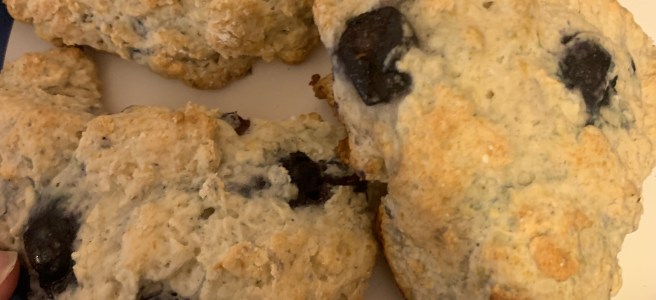
Rustic Blueberry Scones

Day 22 in isolation, and I made these yesterday. By request, here is the recipe:

2 1/4 c. Baking mix. (I used Bisquik, but you could also use 2 c. flour mixed with 2 teaspoons baking powder and 2 teaspoons salt, cut with 1/2 stick cold butter

2 T. Sugar

1 c. Fresh or frozen blueberries.

2/3 c. Cold milk

Stir the sugar and baking mix together, then add the blueberries and toss to coat. Add the milk all at once and mix gently until it just comes together. Dough will be sticky. Turn out onto a lightly greased baking sheet and pat into a rough square about 3/4 inch deep. Using a sharp knife or pizza cutter, cut the dough into eight wedges. Separate them on the same pan so that the wedges are at least an inch apart.

Bake at 425 degrees for about 15 minutes, or until golden. Serve warm with butter.