On Visiting the Grand Canyon

It’s bitterly cold in Minnesota this week, and it’s making me think about our latest trip someplace warm. Our family went to Arizona to see the Grand Canyon in October, and we all loved it. In fact, we all rated it as better than Disney in some respects.

We arrived in Phoenix when the weather was turning cool in Minnesota, and Phoenix itself was hot. We rented a car at the airport and drove up through the mountains to Sedona, then on to Williams, Az. From Williams, we took the train into Grand Canyon National Park, where we stayed as Maswik Lodge for two days before reversing out trip back to Phoenix.

What made it more fun than Disney? I think it might have started with the train. We purchased tickets on the Grand Canyon National Railway, staying in their hotel the night before and the night after our trip. The station in Williams anchors a train line that runs right into Grand Canyon National Park, and it’s been there for more than 100 years. The cars vary from old nineteenth century Pullman cars to modern luxury cars, and the ticket prices vary accordingly. We decided we preferred air conditioning when riding in the desert (a wise choice), and bought tickets to the 1950s car.

We arrived the night before our ride, checked into the Railway Hotel, and ate from the buffet at the Fred Harvey Restaurant next to the depot. There, we started learning about the legacy of Fred Harvey, a nineteenth century entrepreneur who brought fine dining to the west and southwest, and imported young women of impeccable character to serve the travelers at his hotels and restaurants. These “Harvey girls” married locally, helping to establish communities at the stops along the route that Harvey hosted.

One of these original Harvey properties actually exists in Grand Canyon National Park.

We enjoyed excellent food (I had beef tenderloin) and live music before heading back for some swimming at the hotel pool. The excitement about the train built as the night wore on, and we were up early the next day for breakfast at the buffet.

We also took advantage of the restaurant’s packed lunch service. We were told that dining in the park could be challenging, and restaurants were not always open. For a reasonable $17, we got an insulated lunch bag filled with a sandwich, bottled water, trail mix, cookie, fruit, and cheese stick. The lunch bag itself, emblazoned with the Grand Canyon National Railway logo, made it worth the price, and as our day unfolded, we found the snacks and water to be invaluable.

Once we’d picked up our lunches, we went to the depot. Our luggage was handled separately, and frankly, I felt a little spoiled by not having to haul luggage onto a train. I think that might have been my favorite part, personally. We were able to just take our lunch bags and backpacks to the depot. There, we were treated to a skit put on by a crew of terribly inept cowboys. We immediately suspected shenanigans, especially since they kept getting up after getting shot, and our suspicions were confirmed when some of the crew–including the sheriff–followed us all onto the train. We found our seats easily, and as our train left the station, our porter treated us to an introduction to the train, the Park, and the history of the area. He emphasized drinking lots of water, again, and I finally caught a clue. We were heading into a desert.

Definitely time to buy a water bottle or four. I bought four water bottles on the train, and they proved to be extremely helpful to our staying hydrated the rest of the weekend.

The train also featured a singing cowboy who started a sing-a-long in our car. We already were having a great time when the train pulled into the station. Our first views of the Grand Canyon village were of a pretty little mountain town. We had tickets for a tour right away, and we went to find our bus. Once on the bus, we opened up our sack lunches for a snack and a drink, and chattered at each other as the bus took us upon the South Rim to our first stop: Mojave Point.

Friends, I cannot describe the experience of seeing the Grand Canyon for the first time. I can tell you that every single person on the bus said, “Wow!”, involuntarily, when our bus came around the corner of the mountain and we saw it for the first time. It’s vast, layered with stratified rock, a ribbon of river at the very bottom, which is so far away that it’s hard to recognize its scope. We were stunned, and a little afraid. When we got out of the bus to walk out on the path, I kept my children firmly away from the edges and railings.

But that view? Worth every penny.

We took lots of pictures; my girls had their iPads along and were taking video of everything. Our tour took more than an hour, and took us to all the main high points along the South Rim. When it returned us to the village, it took us to Maswik Lodge, which was our lodging for the night.

Maswik features clean rooms that have their own entrances and exits to the outside. Ours had a patio off the back into the woods from which we were able to view deer and other forms of wildlife. We could walk up to the food court in the main lodge any time we were hungry, and take a trolly bus to any other spot in the park on our whim. If we were still hard core backpackers, we could have outfitted ourselves easily with what we needed to hit the trail.

As it was, we decided to walk gentler trails along the South Rim, from one point to another, and to spend some time at the big Visitor’s Center with its indoor and outdoor exhibits. We also made time to send postcards from the village post office and just relax to the sound of the wilderness around us.

We also dug into the area’s stories, exploring the original Fred Harvey property there and eating at its cafe. When we left on the train to head back to Williams, two days later, we felt invigorated.

Then we were robbed on the train. Of course, these were the same inept crew as before, and I was able to buy them off with one shiny gold U.S. dollar coin. But still, it made us giggle as we saw the sun set from the train window over the mountain.

I’m sure we’ll return.

On remembering at Thanksgiving

I don’t even know how old this pot is. It’s a roaster. Big enough for a 20 pound turkey. Big enough for a family feast of fried chicken at the Fourth of July. Big enough to feed crowd.

This one belonged to my grandma Elsie. My childhood surfaces every time I bring it out, memories of this very pan filled to the brim with whatever she was serving to the crowd in her kitchen when we visited. Thanksgiving was always at Grandma’s, even after she downsized, left the farm, moved into a trailer, and then to an apartment in town. Often, more than 50 of us—family and extended family alike—gathered in the community room in her building for Thanksgiving dinner.

We’d have at least two turkeys. The menu also reflected the whims of whomever was bringing sides. There was always mashed potatoes, and gravy, and stuffing. My mother’s baked beans, sometimes sweet corn, and sweet potatoes speckled with marshmallows sat at the table next to occasional treats brought by cousins who lived further afield than rural Wisconsin.

We ate. We gossiped. We played games of all kinds. We’d have a cribbage tournament sometimes. Other times we’d find the Macy’s parade on the little TV in the corner, followed by whatever football game was playing. (Bonus points for days when the Packers played the Lions.)

This year looks a little different. None of us are traveling, to keep us all safe. This pan is out in my kitchen, ready for the turkey, which I fully expect my small family will be eating for the next week. I have lots of little treats for us to nibble on over the course of the day, and the parade is already on. We’ll connect with other family members later today over the phone. And as we give thanks, we’ll remember we have food, we have shelter, and we have love.

Best wishes to all of you on this Thanksgiving.

A Letter to My Graduate Students

I’ve read this letter out as part of the @letterslive project. It was a letter I wrote to my graduate students this morning as part of our weekly check-in. It reflects this moment in time, and the particular challenges of teaching about media. The parameters of the request from Letters Live, outlined by Benedict Cumberbatch in this YouTube video, ask that we read our letters out loud on video. Readers are not required to use their faces, hence, my voiceover with my favorite fabric background.

The text of the letter, which is read out loud and posted on Twitter, is here:

Good morning from Minnesota!

As someone who works hard to manage chronic clinical depression, I’m finding this week’s material, which focuses on health communication, doubly challenging to talk about within the framework of COVID-19. Some of your posts and reflections have struck deep chords with me, and I’m struggling to contextualize what I know about media as a social institution with what I’m seeing across our news and other media platforms.

We in journalism often are careful to make a distinction between news and “other media.” It’s a necessary line we draw in order to help us focus on what society needs from news sources and what society wants from media. However, it’s clear to me that the average media consumer makes no such distinction. The image of a woman’s screaming face protesting a state lock down by shouting the “Media is the cancer!” hurts my heart. I don’t think it’s an exaggeration to say that without media, more people would be dead at this point of the pandemic. And yet. And yet.

So, I’m personally balancing my rage and hurt with, ironically, some entertainment media. I’ve been watching John Krasinski’s “Some Good News” program on YouTube, and it’s made me cry every week. I watched the Disney Sing-Along last week with my little girls, and cried some more. I managed to watch two back-to-back episodes of Dr Who  in a worldwide simulcast on Sunday, and followed several of the original cast as they tweeted along. It helped, a lot, to feel connected to people who want to share something happy.

As we look ahead to our last week of classes, next week, I’m trudging through what needs to be done. I do want you all to know how much I appreciate your discussions and contributions to class. You all have made this experience incredibly rewarding.

Think, next, about how you would put your newly acquired understanding of media theory and practice to work in teaching an intro class. I know that some of you have already had this experience; others are looking forward to trying it for the first time. Every classroom is different, and will face interesting challenges. The key to making it work, I’ve always thought, is flexibility. Provide the framework and the materials to learn the material, but be flexible in how that it shaped. Take advantage of teachable moments. Media examples, past and present, will be your friends as you strive to help your students understand and evaluate materials.

Please know that I am thinking about all of you as we finish out the term. Stay well.

Dr L

What’s in the box? Investigating an impulse to preserve

The first Thanksgiving after my grandmother Elsie passed away, I looked through her cookbooks to see if I could find the recipe she used to make the chocolate cake with date filling she made every year for my father’s birthday.

I pulled out The Farmer’s Wife Cookbook, and it flopped open to the exact page, with notes in her own handwriting.

At the time, I cried a little. The memory of my grandmother, the tradition of the family, and the legacy of food, farm, and life all sort of coalesced into this moment of love. It was not the only moment that led me to start researching American farm women’s lives in the early to mid-twentieth century, but it is one that gets repeated every year, as another food tradition, family tradition, or farm tradition sneaks up on me.

I’m not alone in this. When I was actively conducting research for my book More than a Farmer’s Wife, based on my dissertation, I met with dozens of women who had been raised on American farms between 1910 and 1960. A note in Taste of Home‘s request column also yielded dozens of letters from women who had that farm connection. In the end, I collected more than 200 individual stories from women with first-hand experience of that period on the farm to add to my impressions of their stories from the farming magazines of the same time.

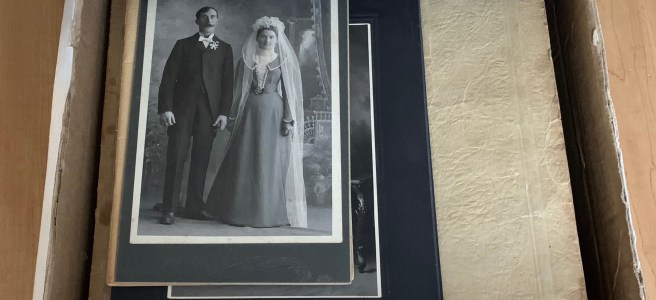
Among what I was sent was a box.

Inside the box were genealogies, pictures, scrapbooks, and a journal, tucked in with a note on the top about how I might be able to find them useful. I did not, however, have a return address. I could not use them for the project that I was working on at that time, but I could not bear to throw the box away. These are someone’s memories; someone’s family history; someone’s traditions.

My colleague Heather McIntosh and I decided now is a good time to investigate the box.

Heather is the genius behind Documentary Site, and together, we’re going to blog about a project that will open up and archive the contents of the box for an interactive documentary. Today, we start with her blog about the process we plan to take, and my blog about the story behind the box as I currently know it.

I was also sent scrapbooks, photos, and other bits of material culture as part of that project, and I ended up with far more material than I actually could use. At some point, I’d like to do more with it.

But for now, we want to know: What’s in the box?


Thoughts on the New Year

I hadn’t intended to do a year-end wrap up this year, and I’m still thinking that it’s not quite the right thing to do.

For all that I accomplished in 2019, it was a very difficult year for me personally.

I wrote more than 100,000 words across multiple formats and platform, including 90,000 words of fiction that may or may not become something.

I got a grant and traveled to England for two weeks, where I conducted research and gained a much-needed change in perspective and respite from the everyday.

I returned to school, took up my seat as chair and helped lead the charge to forming our new School of Communication.

But nearly every day was a struggle. My own battles with depression and anxiety sort of overshadowed many of my achievements. Weekly therapy is now a thing, and it’s a helpful thing.

I think we don’t spend enough time as a society focusing on our mental health. I know that I grew up thinking that any problems “in my head” demonstrated weakness, and I simply had to get over it, whatever “it” was. I developed numerous techniques to hold the darkness at bay, including secluding myself with a book.

(Former classmates might recall that I spent every lunch during ninth grade with my nose in a book, tuning out the world around me. That marked the start of the worst of my teenage depression.)

I also got involved in multiple activities. Keeping busy, I thought, would help keep those shadows away. I wasn’t completely wrong. Anything that could get me out of bed, out of the house, and moving in a positive direction was a good thing.

Back then, I could not have accepted help from a mental health professional, even if it was offered. But now, I know better. Accepting help–seeking help–is the only logical, and most important, action one can take when facing problems with mental health. Depression and anxiety at this point are old adversaries, but therapy has helped me open some new doors to acceptance, healing, and management that I’d never before considered.

As we move into 2020, I plan to continue to set goals for myself professionally and personally. I plan to keep my writing pace this year, and to seek out opportunities to publish my work. I plan spend more time with my family, and to see new places.

And I plan to continue to focus on my mental health, because I’m important.

You are, too.

Frozen 2: The importance of the personal journey

I’ve been meaning to write this review for a month, as I managed to see Frozen 2 the first weekend it was out. My youngest daughters, their biological grandmother, and I went to a matinee the first Saturday of its run.

I need to preface with a little backstory: My five-year-old adores Elsa. “Let It Go” has become the anthem that she sings at the top of her lungs as she runs around the house with an Elsa-themed fleece blanket draped around her shoulders, and the key phrase that gets yelled is, “Stay away from me!”

Appropriate, because A is cripplingly shy with strangers.

So the moment we all saw the first Frozen 2 trailer, we knew we were going to go.

And frankly, I thought the second movie much better than the first, but that’s probably because it resonated so deeply with me as an adult.

The story this time focuses on the major theme of “becoming”: how one finds their place in life. Elsa learns about her origins and purpose; Anna learns what it is to be alone and how to manage that; Kristoff learns about his role in their story; and Olaf learns what it means to grow up.

The story begins in autumn, rather than winter, with the music reflecting a somewhat ominous theme in a contrastingly cheerful tune, “Some things never change.” This, of course, foreshadows that things inevitably do change, and viewers are left to watch the journey of these characters as they grow into themselves. Elsa hears a call that she can’t resist following, and Anna insists on going along. Where Anna goes, Kristoff follows, and therefore we have that trio plus Olaf and Sven heading on an adventure into an enchanted forest in the far north.

All is not as it seems in the enchanted forest, and as the story progresses, each character faces some hard truths. In the end, of course, all is well, if different, and along the way we learn that change is hard, but it can be handled, one step at a time.

The pacing kept the attention of my preschoolers, which has become my standard gauge of interest. When things looked to be getting too scary, Olaf popped up with something to lighten the mood, generally. But at one particularly low point in the film, Olaf, himself, is gone, and Anna is left to pick up and move on entirely alone. Her song, “The Next Right Thing,” felt like my personal anthem when I heard it. I was not the only adult in the audience who cried.

However, this is Disney; everything turned out happy in the end, if different than before. But the theme remained: some things never change; some things stay the same; but some things do, and change doesn’t have to be bad.

It’s a good lesson, delivered with entertaining grace. We loved the film, immediately downloaded the soundtrack, and started singing a new tune around the house. One girl will call out, “Ah-ah-ah-ah” in a perfect call from the woods, and the other will answer.

Soon we’re all headed “Into the Unknown” for our own adventure.

P.S. : A is getting an authentic Elsa costume with cape for Christmas. I’m really looking forward to seeing her face.

The Holiday Pot-Luck

Today, my department hosts its now-annual potluck to kick off December’s rush of finals, graduation, grading, and paperwork.

As a tradition, the potluck apparently got its name from Thomas Nash, who discussed added guests in terms of whatever’s available to feed them–the luck of the pot. However, it’s evolved to be a communal meal to which guests all contribute in one form or another. Laura Ingalls Wilder writes about a communal Thanksgiving dinner held in DeSmet, S.D., one year, sponsored by her church, where the members of the Ladies Association brought different dishes to share for a fee.

My first exposures to potlucks? Well, I can’t even remember. It seems they’ve always been a thing, though I do most closely associate them with the church ladies of my childhood, frankly. But every meal as an extended family functioned similarly; no one person provided all the food for any particular meal. All took part.

Thanksgiving became a perfect showcase for the potluck and for family dishes. Though snow prevented us from traveling this year, we were ready with our contributions of pie and cupcakes. My sister, brother, mother, and I texted back and forth for a few weeks to determine the final shakedown of who would bring what to ensure everything was covered.

The office potluck is a bit different. No one knows exactly what everyone’s bringing, just that everyone should bring something. To that end, I’ve evolved into the potluck person who brings some sort of hot dish to share that’s heavy on protein. There’s never, ever, enough protein at a potluck, especially at a holiday where sweet treats are the norm.

This time around I made meatballs from scratch, which, as I write this, smell amazing. the aroma brought all the participants to the front office to load up a plate. We’ve also got a variety of other treats at the table, and that’s half the fun of a potluck. You never quite know what’s going to be on offer.

Amy’s Meatballs

Suitable for spaghetti, sandwiches, and plain-old snacking, meatballs are family staple. My general recipe is actually a rule-of-thumb kind of thing: One pound of ground meat to one cup of fresh bread crumb to one egg, plus seasoning.

The batch I made for today turned out really, really tasty. I used jarred tomato sauce for the coating and kept them hot in a crockpot.

3 lbs 80/20 ground beef, thawed

2 cups Italian-seasoned dried bread crumbs

1/3 cup milk

1 T. salt

1/3 cup grated Parmesan cheese

2 eggs

Blend the crumbs, cheese, and salt; add milk and stir together.  Let stand for a few minutes to “freshen” the crumbs. Crumble the ground beef over the top. Add the two eggs; mix with your hands until combined. Don’t knead too much or they’ll get rubbery.

Portion out into 1 1/2 inch balls on a baking sheet. Bake at 375 for 20 minutes.

Once out of the oven, you can sauce them any way you’d like. I added this batch to a crockpot with four cups (two jars) of spaghetti sauce. If you used plain bread crumbs and added allspice and celery seed to the main recipe, you could sauce with mushroom cream gravy for Swedish meatballs. As I said, it’s more of a rule-of-thumb than a true recipe.

Enjoy for your next potluck!

A Saturday at the Great Minnesota Get-Together

Every year, the Minnesota State Fair calls all comers to visit, eat, play, talk politics, and view the best of the best of the farm-produced animals, produce, crops, and goods available in the State. The event happens at the end of August, culminating in Labor Day, and for some, it’s an event not to be missed.

I first went to the fair almost twenty years ago, when I was working on my doctorate at the University of Minnesota. My husband and I lived in a tiny apartment in a complex right next to the grounds, and complex residents received free tickets to the fair to compensate for the hassle we faced during the season just getting in and out of our driveway. So, we went.

It’s become a bit of a tradition, ever since.

We haven’t been in the last few years, because it just hasn’t been possible for one reason or another, but we found that we had a free Saturday during the fair, with weather projected to be utterly gorgeous. We bundled up our preschoolers and headed to the Twin Cities early, to try and beat the “big” crowd, which was futile, as everyone else had the same idea.

We’ve learned a few things in our time going to the fair. First, never park next to the grounds. On truly beautiful days, those lots fill up fast, can cost quite a bit, and can be difficult to navigate to and from. Our preference is to park in an express park-and-ride lot and take the express bus right to the main gates. It’s cheaper, more convenient, and we don’t have to deal with fair traffic. This year, we parked at the Mall of America express lot across from the East Parking Garage.

I bought our transit tickets on the Metro Transit app, showed them to the friendly Metro Transit staff, and on we hopped–two adults and two preschoolers for $10, round trip. (Next year, the same trip will cost us $20 as the girls will be too old for the under five discount.)

The bus took us directly to the main entrance and Transit Hub at the back of one of the University of Minnesota St. Paul Campus parking lots. There, we could purchase tickets on site. We opted to buy ours online, and present the bar code for scanning on my phone to gain entrance to the grounds. Once inside, we headed directly for the West End Market, perched at that entrance.

The West End Market used to be Heritage Square, and traces of that history remain in a newer building that offers a displays and exhibits about the fair’s history and the art that surrounds the newer open-air stalls with goods that speak to Minnesota’s past. I stopped at the Watkins booth for vanilla extract, a staple in my kitchen. Matt took the girls to the shaved ice cart for two enormous confections that we all shared before girding our loins to head toward the Midway.

Because it was a beautiful Saturday at the fair, the crowds were challenging to navigate. I’ve seen, in the past, crowds so thick it would be easy to body surf through them. We managed, though, scooping up a bucket of fresh french fries, taking a turn at a feat-of-strength game booth, and viewing horses. We followed one lone sheep on a leash up Judson Avenue toward the international market, another favorite stop, and made use of the restrooms next to it.

(Restrooms at the fair are another big story. Fun fact: It was coverage of the 1911 Minnesota State Fair that led me to the work that would define how I approached my dissertation and later book: The Farmer’s Wife magazine. A reporter asked the editor of the Farmer’s Wife about the new restrooms on Machinery Hill at the fair, which were meant to offer farm women a respite from their corsets and other accoutrements. They were well-received.)

In recent years, big, well-maintained facilities have been added near the big market places to supplement existing restrooms, and while there will still lines on the women’s sides, the addition of family restrooms made it much easier to get in and out with two little girls who had to go, like, right now.

At the International Market, Matt took the ladies around the booths while I held a spot in the benches in front of the stage, which featured music by Papa Shalifa in the style of the Caribbean. We listened for a while, dancing, until we needed to escape the crowd and head toward the street to find some lunch.

We bought fresh, piping hot corn dogs from a truck on the corner, and turned up the road to find a spot on a bench facing the street  outside the main food building. We ate our corn dogs, drank our bottled water, and played with the new toys the girls had won at the strength booth. We watched the crowds, and I headed into the food building to get another fair favorite: deep-fried cheese curds.

The line for the curds stretched out the doors on both sides of the building, but it went very quickly. The booth is popular enough that the staff there have the procedure down. Present cash only at the window, get your ticket, then move down the counter where someone will take your ticket and hand you your curds. I got a bucket. It was a theme, OK? And we ate them all.

Keeping our spot on the street became important when  we realized the daily 2 p.m. parade was about to start. The girls clapped and waved at the bands, the farm and community princesses, the funny floats, and the Shriner’s cars. We loved watching the crowds go by.

After the parade, we ambled up another block and over to see some more of the booths, the food, and the fun. We watched people slide down the giant slide for a  minute, then looked through the merchant booths in the grandstand. We took a break, then, hanging out in the shade under the grandstand and trying to decide if we were up for doing anything else at the fair.

We decided we had to do one more thing: Get a bucket of chocolate chip cookies from Sweet Martha’s, a fair tradition that goes really well with the ice cold milk they also sell. We munched as we made our way out the same way we came in, taking the bus back to our car.

If you really want to do the entire fair, you’ll need to go more than once. That said, we managed to eat all the fair food we were craving, see a show, catch the parade, see some animals, go shopping, and enjoy the sunshine, so we felt accomplished. If you want to go, the fair runs through Labor Day. Our girls weren’t interested in the rides, but they have those, too. Have fun!