
Mary Poppins Returns, And Delights

We took the little girls to see Mary Poppins Returns on opening weekend, and we all gave the movie two thumbs up.

The original Mary Poppins movie has become somewhat of a staple in our house over the last year. I introduced it to our little girls last winter, after I broke my leg, as my concession to a need for quiet time. They loved it. Songs from the film now litter our bedtime song-and-story routine, and C absolutely must hear “Let’s go fly a kite” before she falls asleep herself.

When we saw the first preview for Mary Poppins Returns, everyone said, “Ooooh.” And we immediately made plans to see it.

First, I need to say that taking a three- and four-year-old to the movies is a task best approached cautiously, for numerous reasons. I normally don’t allow the girls to watch anything I haven’t watched myself, first. I also recognize that sitting still for two hours or more is a task a preschooler has a tough time achieving. So we’ve only gone out to see a movie twice before: For Finding Dory, at the downtown second-run theater at a matinee that included an audience of many, many small children; and for Incredibles 2, which held their rapt attention (though I did have C buried in my neck for some parts).

Mary Poppins Returns, I am happy to report, kept their attention for the entire film. They loved the music, and the animation effects, and the characters.

I loved the story, too.

Watching the Poppins stories as an adult adds a layer of complexity to understanding them. For the little girls, it was about the children, with the help of their nanny, triumphing over the “naughty guys” and having fun with their family. For me, though, I saw the entire story as being about dealing with a grief so deep that it tears a family apart, and the family needs a bit of help to stitch it back together and gain new form.

The decision to provide a sequel to the original Mary Poppins, as opposed to remaking it, was sound. The sequel provides a new story, catches us up on what happened after the credits rolled for the first, and introduces a new character or two, while keeping very much in touch with its roots.

We discover that the elder Banks have passed away, leaving behind the house and a legacy in the form of shares of the Fidelity Fiduciary Bank. We find that Jane Banks works as a labor organizer, and Michael Banks, an artist, took a job as a bank teller in the wake of his wife’s death, to make ends meet and pay off a loan he took to manage her final expenses.

We find that Michael’s three children have sensibly been raising themselves, as their father is drowning in his own grief and their housekeeper, Ellen, has been steadily losing sight of reality.

Michael’s fit of despair over the bank’s declaration of intent to repossess his home results in his tossing out the green kite that ends the original Mary Poppins, and it is this very kite that comes back to his son, Georgie, attached to the nanny herself.

The rest of the story offers adventures as the children anxiously plot to help their father, who must prove he has the shares in the bank by finding them. Mary Poppins wisely allows the family to come to its own healing, while she judiciously and silently assists.

The story arc and musical numbers parallel the original: establishing the characters and the problem, offering an insight into the magic that is Mary Poppins, and finding some sort of redemptive and uplifting closure. While the music is entirely new, the musical director wisely uses themes from the original, in instrumental forms, to remind the audience of specific points in the first movie that are relevant in the second. One example is listening to the bank’s theme song as characters move through it; another lies in the use of the “let’s go fly a kite” theme when characters traverse through the park.

There’s also the musical number that could have been cut; in the original, it’s “I Love to Laugh,” which only had the purpose of telling the joke that eventually saved Mr. Banks’ job. In the sequel, it’s “Turning Turtle,” which, while fun, doesn’t do much to further the story, other than to break the children’s hearts a little bit and let Meryl Streep be in the Mary Poppins sequel.

We also see the big street number in both: “Step in Time” for the original and “Trip a Little Light Fantastic” in the sequel.

But, honestly? I cried a little bit. Okay, a lot. Because in the end, of course, the Banks children save their home with Mary Poppins’ help, and the elderly bank president, son of the original Mr. Dawes, (played enthusiastically by Dick Van Dyke, who can still do a mean little tap dance), tells the children the story of Michael’s tuppence, which had been safely invested by Mr. Dawes after the original film and had grown nicely to an amount that would pay off their loan without losing the family shares in the bank.

The lovely Angela Lansbury starts the final number, which takes place at a fair in the park, and the theme, “Nowhere to Go But Up,” reminds us all that there’s hope in a dark, dark, world.

I enthusiastically recommend seeing the movie, especially if you were ever a fan of the first. I think it will be my go-to for the days that seem dark, because it’s always good to remind oneself that there’s nowhere to go, but up.

Seeing the Lights

One of my favorite things to do in winter is take a drive after dark and see the lights on display. In my hometown of Chippewa Falls, Wis., driving through the light displays in Irvine Park is an annual Christmas Eve tradition, and it’s one that numerous communities are starting to embrace as a means of sharing the goodwill and joy of the season.

Locally, the Kiwanis started a holiday light display in Sibley Park a few years ago, and it’s become another annual tradition. The Kiwanis Holiday Lights provide nightly entertainment for the darkest month, and there’s something for everyone.

We took our family to see the lights for the first time this season last night.

The girls noticed the lit-up Santa, Mrs. Claus, and a single reindeer first. But as we drove through the front gate, they started chattering excitedly about the Disney characters they could see on display in the miniature horse enclosure.

We pulled up to the night’s volunteers (who collect donations for area charities; last night’s was a favorite of ours, The Reach), handed them a donation, and accepted a program that detailed the events of the night and the sponsors of the program. We obediently tuned our car radio to the dedicated frequency set for the park, and proceeded, headlights off, to the parking lot next to the warming house, where we could stop, get out, and start our stroll through the wonderland.

The girls hurriedly bundled up in their warm weather gear, and we made our way to the marked path that took us first through the main body of the “farm” part of the park.

In warmer weather, Sibley houses several varieties of young farm animals for feeding and petting, right next to its farm-themed playground. By night in the winter, these paths are lined with lights, and the enclosures filled with things like ice sculptures, the Disney display mentioned earlier, and live reindeer, which are penned in behind much higher fences than usually found at the park.

The live reindeer, in fact, were C’s favorite, and she wanted to come back to them again and again over the course of the night. We saw them first, then strolled along to the warming house, where volunteers served up hot drinks, popcorn, and mini-donuts next to Jack Skellington and his company. We bought a bag of hot mini-donuts, and another of popcorn, to share while we looked out the large picture windows to the view of the Grand Lawn, adorned with the tall tree made of lights.

When we were warm, we headed back outside to stroll down the metal platform path onto the lawn itself. It rang merrily with the girls’ boots as they tried to run (and were firmly told to use walking feet). Many giggles accompanied selfies on the bridge, and then we scampered back to our car so that we could drive through the rest.

We listened to the music on the radio as the lights danced in tune, driving slowly through the display so that we could really enjoy the way the different sections (snowmen, snowflakes, waves of lights) coordinated their dancing. We admired the different trees decorated for the tree competition, and we tried to count how many Santas we could see in all the different displays.

As we started down the road to exit the park, we spotted Santa in his sleigh, with all his reindeer flying directly over the road ahead of us, all lit up. We had a lot of fun being out after dark.

If you go, know that Fridays, Saturdays, and Sundays feature a live Santa and wagon rides as well as the displays. Information on hours and special events can be found on the Kiwanis Holiday Lights web site, linked above.

Happy Holidays!

The Bleak Midwinter and the Joy of Holidays

I’ve had a couple of interesting interactions lately about my use of “Happy Holidays” instead of “Merry Christmas” when I’m not certain about the religious training of the person to whom I am addressing the greeting.

Most people are happy to reciprocate with a “Happy Holidays” of their own.

But there have been a couple who seem to get angry that I’m not using their traditional holiday greeting. One even went so far as to add the reasoning that this holiday season wouldn’t exist without their particular religion.

I want to be clear about this: I am a Christian, and the fundamental tenet of Christ’s teachings remains rooted in love for all people, period. We don’t get to pick and choose whom we share the love with, because we are all deserving of it. One of the bones I have to pick with many evangelical leaders is that their teachings often lead to hate and anger, which directly conflicts with Christ’s word on the subject. And that hypocrisy irritates me to no end.

That said, Christians are actually pretty late to the midwinter celebration parties.

Celebrating light in a season of darkness has a long history. Many pagans in the northern hemisphere celebrated on the Solstice, which marked the shortest day of the year, and the need for light in the darkness was highlighted.

Hanukkah celebrates a Festival of Lights in remembrance of the Maccabean Revolt that took place more than a hundred years before the birth of Christ.

In some years, Ramadan also falls in midwinter, aligning the Islamic tradition of fasting, prayer, and charity in the ninth month of the Islamic calendar with other religious celebrations.

Kwanzaa, celebrated at midwinter, is another latecomer, arising out of the need to connect peoples of the African diaspora in their scattered locations, but it focuses on unity, self-determination, collective work and responsibility, cooperative economics, purpose, creativity, and faith.

All of these celebrations, at their heart, look to battle back the dark, to celebrate the light, and to renew faith, in whatever form that takes for the celebrant.

Christians celebrate the birth of Christ, even though historical documentation suggests Christ was actually born in the spring. As an educated Christian, I’m fine with the tradition of celebrating His birth at midwinter, not only because it’s tradition, but because the celebration of His birth does all of these same things.

The celebrations renew our strength in the battle against the dark, and our faith in Christ’s love.

Extending the courtesy of “Merry Christmas” to anyone, of any faith, simply reflects good wishes for the person addressed. “Happy Holidays” does the same thing, with a respect for the beliefs of the person addressed also implied. Either or both are acceptable, because they are meant in good cheer.

Battle back the bleak midwinter, and take no offense from those who would wish you well in the effort.

Baking for the Holidays

I’ve spent the last few days in a baking marathon, getting ready to gift treats to friends and families for the holidays.

Said marathon was accompanied by eight inches of snow and two enthusiastic preschool helpers, who had a great time playing with all sorts of cookies.

When I’m able, I like to make one new cookie each year, followed by an assortment of old favorites. This year, so far, I’ve made my comfort chocolate chip cookies with a mix of butterscotch and chocolate chips, stir-and-drop sugar cookies with a green glaze, lemon-sugar cookies with a lemon frosting, fudge, and assorted chocolate-covered pretzels.

I still need to make, per tradition, chocolate-covered peanut butter balls and gingerbread cookies.

I’ve been posting pictures of the treats as I make them on Facebook, just to tease my friends and family. It’s been fun. And I dropped off my first treat box today, to my department’s treat day. It’s the week before finals in the Department of Mass Media, and for a change, I’m not a part of the general wash of frantic activity.

I have, however, been busy.

I mentioned several weeks ago that I had serious writing goals for November.

I presented at a conference, and I managed to write more than 25,000 words on my original fiction. I also made it through literature review and preliminary research for the main paper I’m working on as part of my sabbatical, so I’m feeling pretty accomplished.

I’m also thinking about a draft abstract for LauraPalooza, the deadline for which is Wednesday of this week, so I’d better move on it if I plan to.

But as snow fell this weekend, my focus was entirely on my family, and my young taste-testers, who love to smell every ingredient before I put them in the mixing bowls.

Lemon was a “thumbs up” from my younger, but a “thumbs down” from my older little girl. Fudge was “thumbs up” for my older little girl, but a “thumbs down” from my youngest, despite her trying it twice. They have widely different tastes in some areas!

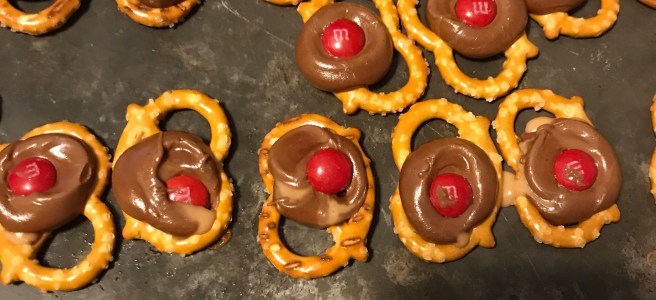
But both love getting to help. With supervision, they made a bunch of white-chocolate-covered pretzels, decorated with green M&Ms, and placed Rolo candies on other pretzels for the Rudolph treat.

I look forward to helping them learn to make the other treats as they grow.

Giving Thanks

We celebrate Thanksgiving this week. My refrigerator is packed with everything we need for a meal that showcases abundance, and I’m thrilled that all my kids will be home for the holiday. We have much to be thankful for.

I’ve got three bundles of collard greens ready to go. I have an enormous turkey ready for roasting. I’ve got bread dough, and carrots, and potatoes, and stuffing. I baked chocolate chip cookies over the weekend, and I have three pies in the freezer.

I think we’re set for food.

But what I look forward to the most is hanging out with the family. We have some games to play after dinner this year–the youngest girls are ready for Candyland and Chutes and Ladders–and since my son is in town, I think we’ll put up our Christmas tree, too.

Thanksgiving has always meant family to me. Up until my grandmother, Elsie, passed away in 2001, I spent every Thanksgiving in her kitchen, helping to produce the enormous feast we needed to feed the Mattson family. We used the community room in her apartment building, and we often had, at minimum, fifty people eating.

We’d go through two twenty-pound turkeys, cooked on Weber grills or in Grandma’s oven, along with numerous sides, including a sixteen-quart stockpot full of mashed potatoes. One of my earliest cooking memories, in fact, is peeling potatoes for that pot, alongside my cousin, Nicole.

(Leftover potatoes, if there were any, would become lefse. That’s another post, but we rarely had enough leftover potatoes to do a whole batch.)

As Elsie’s eyes deteriorated, she had to move to be closer to family, and the communal thanksgivings changed venues, some at my parents’ home. After she passed away, her sons’ families sort of passed it back and forth, but we’ve really outgrown one location for Thanksgiving.

Now, I host for my immediate family and their extended, local, biological family. We’ll FaceTime with my parents’ and the entire crew eating in Chippewa Falls. We all have so much family, that figuring out where everyone is going to eat, and when, and whether we’ll have time to visit others, is an ongoing debate.

But that’s something to be thankful for, too. We all have several places we could go to be loved, filled with thanks, and fed.

Peace to all of you this week.

Comfort Food for a Snowy Monday: Saucepan Brownies

I just got back from a great, but quick, trip to Tennessee to speak at the Symposium for the 19th Century Press about my mentor, Hazel Dicken-Garcia, who was an avid supporter of that annual event.

It was good to see old friends and reconnect. I came away with numerous ideas for upcoming research projects and more invitations for visits and trips and conferences.

I also came away a bit blue, so today, I’m posting my recipe for quick saucepan brownies.

This is another recipe that I no longer need to look up. When we want a quick, chocolate, treat, this can be whipped up in five minutes and in the oven. Within the hour, we can be savoring warm brownies, sometimes with frosting, sometimes not, but always delicious.

Preheat oven to 375 degrees. Grease an 8 by 8 baking pan.

Melt together:

1/3 cup baking cocoa

1 stick real butter

Remove from heat; let cool briefly. Add:

1 cup white sugar

2 eggs

1 tsp vanilla

Beat together with a big spoon until glossy, then stir in:

3/4 cup all-purpose flour

Until it’s mixed in well.

Pour into prepared baking ban and bake 30 minutes, or until it passes the toothpick test.

We often top with chocolate chips when it comes out of the oven, letting them melt and spreading the warm chocolate over the top before we cut into it. We’ve also topped them with scoops of virtually any flavor ice cream you can imagine. I think my favorite is raspberry sorbet.

Enjoy when you need quick comfort food on a snowy Monday.

The Challenge of National Novel Writing Month

National Novel Writing Month, or NaNoWriMo, started Nov. 1. The challenge? To write 50,000 words of original fiction over the course of November.

I accepted the challenge, and although my writing time is limited to an hour chunk here or there, my goal is to write 50,000 words this month.

It seems like a lot, but I like to break down what I write. One of my University of Minnesota Professors, Ron Faber, explained to us, his students, that he broke down his dissertation writing process into five, manageable, pages a day.

When I wrote my first book, and my dissertation, I did the same.

Breaking down the work into manageable chunks daily, rather than viewing the entire thing as a monstrous task, makes the work go faster. My daily writing goal is 1,500 words, which is roughly five to six double-spaced pages.

If I complete 1,500 words a day on the same project throughout the month of November? Well, I’ll have completed that 50,000 word goal.

But do I have the projects?

Yes.

I’m cheating a little with the 50,000 word goal, as all of those words are supposed to be put to the same project. I actually have three projects I hope to complete this month, only one of which is the original fiction piece that may or may not ever see the light of day.

Of the other two, one is the preliminary work and secondary research for the community building and media project I plan to complete in England in the spring. The other is more exploratory essay on the impact of Laura Ingalls Wilder and her work on popular culture over time, something I hope to develop into an abstract for submission to the LauraPalooza conference next summer. That deadline for submission is Dec. 5, Rose Wilder Lane’s birthday.

So while I might not have 50,000 words on the same project completed by Dec. 1, I will certainly have 50,000 words written by then.

It’s good to have goals.

NaNoWriMo also has challenges in April and July, all designed to help writers develop their craft in supportive environments. I suggest, if you want to develop your work and you think an online writing group might help you, check out their website: NaNoWriMo.

(Psst — I’m already 10,000 words in on the fiction project. Woot!)

Soup’s on!

When the weather starts turning colder in the northern Midwest, I start digging out my biggest pots for making soup.

Having a batch of fresh soup simmering on the stove makes the house smell amazing, and the steamy kitchen warms everyone right up. Bake a batch of fresh rolls at the same time, and we’ve got a house that smells like home and a meal ready that satisfies everyone’s need for comfort and deliciousness.

As a grad student, I made soup annually for the grad student committee’s “Bring your own bowl” soup party, usually in October or November, as we all needed just a bit of comfort with finals approaching and cold weather making life a little more challenging. A number of my fellows were vegetarian, so I came up with two soups that remain staples in my pantry: Chicken noodle, for the meat eaters, and cheesy potato, for the non-meat eaters.

Chicken noodle I made the old-fashioned way, which takes a good portion of the day, but yields yummy results. I use a 16-quart stockpot to begin with, and locally sourced, scratch made egg noodles rather than a commercial brand. I can shorten the cooking time for this recipe by using chicken stock as a base, skipping to the after-cooling step, and using boneless chicken breasts as the meat source.

But I do like the way the house smells when the soup simmers all day.

Old-School Chicken Soup

In a 16 quart stockpot, add:

1 whole chicken, giblets removed

3 bay leaves

1 tsp peppercorns

1 Tbsp salt

3 cloves garlic, peeled and crushed

1 medium yellow onion, peeled and diced

4 medium carrots, peeled and sliced

3 stalks celery, cleaned and diced

1 medium green pepper, washed and diced small (including seeds)

1 Tbsp dried sage

1 Tbsp dried thyme

1 Tbsp dried parsley

1 Tbsp dried dill

(Note: You can put all the herbs in a tea strainer or cheesecloth bag, closed tightly, and it will work well for a “clean” soup; just remove at the cooling step. I don’t usually bother, though. Also, these vegetables will stay in the soup until the very end. I’ve seen some recipes that remove and discard the veggies and add fresh after the cooling step, but I think that’s a waste, and I like the texture.)

Fill the pot with cold water. (Using cold ensures that you will extract as much flavor as possible from your ingredients.) Set on the stove and bring to a boil; reduce to a simmer and cover. Forget for at least three hours. (It’s fine to check on it periodically, but don’t go overboard.)

At the three-hour mark, check your soup. Taste the broth with a clean spoon. If it seems weak, remove the lid and simmer for another hour to reduce. (Frankly, the longer it simmers, the more intensely flavored your soup will be.) When it “tastes right” to you, turn off the heat. Remove the chicken to a strainer to cool. Remove the bay leaves, and if you can find, them, the peppercorns. Cool the broth and remove as much of the fat as you can. (If you have time, you can chill it all the way down, and remove the fat in a sheet from the top of the broth. If not, you can siphon the fat off while warm, but it’s messy and not fool proof.)

While the broth is cooling down, start to disassemble the chicken. Remove meat from the skin and bones, and dice up for the pot. When your meat is diced up, and your broth has cooled, with fat removed, add the meat back to the pot, bring back up to a boil, and taste. Adjust your seasonings. This may mean adding more salt and pepper, or even a bullion cube or two, to reach the flavor profile you want. I’ve also added the zest and juice of a lemon at this stage to add a little zip.

When the broth is simmering and tastes just right, add sixteen ounces of fresh wide egg noodles. Cook until done, and serve.

Egg noodles: In recent years, I’ve taken to buying locally sourced fresh or dried egg noodles. I live in a rural area, and it’s fairly easy to find some locally made and for sale in our supermarket or at the farmer’s market. But when I was growing up, we made our own.

For one pot of soup, you need the noodles from this recipe: two cups of all purpose flour, two eggs, and 1 tsp salt. Mix the flour and salt together, make a well in the center, and beat in the eggs. Knead the stiff dough, letting rest periodically to relax the gluten, until smooth. Let rest again, then roll out thin, and cut into strips. Let dry while your soup is simmering.

Cheesy potato soup

This is a smaller batch.

In a large pot, (I like to use my Dutch oven) sauté 1 medium onion, diced; two medium carrots, peeled and diced; 1 stalk celery, diced small; 1 clove of garlic, minced; and two bay leaves in a little olive or canola oil, until most of the vegetables are translucent. (Obviously not the carrots.) Add four medium potatoes, peeled and diced into half-inch cubes. Stir through, then add four quarts of chicken or vegetable stock (or water and bullion cubes).

Bring to a boil, then reduce to a simmer for twenty minutes, until the potatoes are cooked through. Taste and adjust seasonings. It may need salt; potatoes absorb it. A little pepper this stage is good, too.

To a plastic zip bag, add four Tbsp. All-purpose flour and four Tbsp softened butter; seal and knead until blended. Snip the end of the bag off with scissors and pipe the roux right into the soup, stirring constantly. When the soup looks creamy, add two cups of shredded co-jack cheese, slowly, stirring constantly. Finish with a tablespoon or two of fresh chopped dill and serve.

(If you want it to be flat-out vegan, use vegetable stock and omit the cheese.)

Minnesota’s Largest Candy Store worth the stop

One of my favorite places to stop on 169 between Mankato and the Twin Cities features an enormous selection of candy, gourmet soda, and fun. Run by Jim’s Apple Farm, Minnesota’s Largest Candy Store offers more than candy; it offers an experience.

My husband and I have been stopping at Jim’s Apple Farm, known locally as the big yellow barn, for at least a decade, and it’s changed a lot. Originally, it offered fresh apples and other produce in season, fresh baked apple pies and strudel, fudge, and a selection of locally sourced food products. The owners also offered what appeared to be a good variety of vintage and other candy.

Today, the elderly strudel maker has passed away, but the family still offers fresh baked pies, strudels, and apple cookies using the old recipes. They still offer the apples and pumpkins in season, and the locally sourced goods. But they’ve expanded significantly, and what was once a fun and modest selection of vintage candy is now a barn full of candy and snacks from around the world.

Additionally, with the expansion, the owners have incorporated life-sized friends from the Marvel, DC Comic, and Pixar universes in the main candy room, and the round observatory recently added includes suspended models of the U.S. Enterprise, Millenium Falcon, X-Wings and Tie-Fighters, and the Borg cube. At center stage in the observatory is a model of the TARDIS.

Highway 169 has been under construction all summer, so Wednesday was the first time all summer that we visited. We brought our little girls with us (offer a candy store visit to a preschooler and see how fast they buckle up in the car), and I honestly had more fun watching them than I did picking out candy.

First, the new atmosphere expands a point of view so that it always pays to look up. The little girls spotted a life-sized Wonder Woman statue first, and their squeals of “Wonder Woman!” followed by “Superman!” made me giggle. We spotted Iron Man, Thor, Cat Girl, Batman, The Joker, The Hulk, Harley Quinn, Flash, Captain America, the Silver Surfer, and the Iron Man Hulk Smasher all in that first room, looking as if they were ready to do battle over our heads.

As we passed through to the other side of the room, we found Sully and Mike from Monsters, Inc., a minion in a gas mask, and entire animatronic band made up of candy and raisin characters, all life-sized. We watched the band’s show twice–they perform every five minutes–and the girls and I danced along to Motown favorites. My husband was busy taking pictures.

We passed by a Zoltar Speaks machine on our way into the big round observatory room, to find the Borg Cube and the Enterprise suspended on opposite sides of the room, with the Star Wars space ships during it out in the middle, high above our heads in the round dome. The TARDIS took center stage in the room, and we had to pop in and out of it. Unfortunately, it was not bigger on the inside.

But in the observatory room we found a wide and varied selection of candies and snacks from around the world. While the British selection was still back in the main barn, near its red British telephone box, the observatory selection featured candy from Japan, Spain, Korea, and other places in its original packaging.

The girls were allowed to pick out candy for themselves, and that took some time. I picked out a Lion Bar from Britain, something I’ve missed after my stay there many years ago. A picked out a lollipop pop-up toy featuring her favorite character from the movie Frozen and a selection of suckers, while C picked out a box of Smarties. We also got a Chocolate Frog, apple cookies, gourmet soda, and handmade, locally sourced egg noodles (destined for from-scratch chicken and noodle soup).

The bathrooms had an upgrade a few years ago, and now, instead of two, single stalls, we found port-a-potty doors that opened up into spacious restrooms with several stalls and room for a nursing mother to take care of her baby.

We had a fantastic time, and it was well worth the trip.

One note: Jim’s Apple Farm and the Minnesota Largest Candy Store do not accept credit or debit cards, so be sure to bring your checkbook and/or plenty of cash. There are at least three ATMS on-site if you forget, but I’ll warn you: we rarely leave without spending at least $40.

The big yellow barn is located on the west side of Hwy 169 between Belle Plaine and Jordan, Minn. It’s hard to miss, open March through November, and closes for the season this year Nov. 25. I’ll be going back up to get my Thanksgiving pies.

Saying goodbye to a well-loved kitty

My 17-year-old cat, Jerry, passed away in the night.

When we adopted Jerry, he was an eight-month-old kitten considered nearly unadoptable because of his utter shyness. He’d been rescued from the woods with his litter, ill with pneumonia, and his first experiences with humans were the veterinarians who cared for him. It left him shy of human contact, though ultimately well-behaved at the vet and with the people he decided were his.

I was his.

We adopted him because he needed a home, and we needed a companion cat to our then nine-month-old cat, Bear, who was too social to be left on his own during the day when we were at work and school. Jerry’s foster parent brought him to us, because the stress of a public adoption day would be too much for the poor, shy kitten to handle. When it came time to decide if Jerry was staying or leaving, he scratched the poor woman and darted under our couch.

We decided that was a good enough declaration of interest in living with us and with Bear, and we kept him.

It took two weeks before he’d let someone pet him, a couple of months before I was able to cautiously pick him up. Both times were at his instigation. The first time, he jumped into my lap unexpectedly, and jumped right back out. The second time he jumped into my lap, where I was sitting in a recliner, I ran a hand down his back and he purred, and purred, and drooled with happiness.

My lap in my chair became his safe zone. One day, while I was walking down the hall in my small apartment, he planted himself at my feet and howled. I reached down slowly to pick him up, and he snuggled in and purred.

Jerry loved few, but he loved them well.

Over the years, he remained a healthy and loving cat at home, who was shy of outsiders. When we adopted teens, he rarely allowed them to see him, preferring to spend the bulk of his time in my room. When we later welcomed our little ones, he almost disappeared into my room completely.

Within the last few weeks, though, Jerry started to come out of hiding more and more, demanding attention. He demanded cuddles, and got them. He moved slowly, but allowed the little girls to play with him, pet him, and incorporate him into their games. He went outside for the first time in years, playing a slow game of tag with them, and then rolling in the grass.

I was torn between amazement at his sociability, and dread because I was afraid of what it might mean. I intended to take him to the vet this week for a look.

This morning, I didn’t see him in his usual place. And when I went to look for him, I found him curled up, and gone. I did take him to the vet today, but he didn’t come home with me.

He gave us lots of love, and we gave it right back. We’ll miss him.

One more note: Jerry and his brother, Bear, were both jet-black cats, gorgeous animals who had a hard time getting adopted in part because of their coloring. Please, if you’re considering adopting a cat, consider the black ones. They’ve also got a lot of love to give.

Both of our older cats, now gone, were adopted through Cause for Paws, Inc., in the Twin Cities. Our younger cat was adopted through the Human Society in Wichita, Kansas. Both organizations do the valiant work of keeping the feral cat population down and helping those cats in need to find good homes.

Hug your loved ones today.