A Saturday at the Great Minnesota Get-Together

Every year, the Minnesota State Fair calls all comers to visit, eat, play, talk politics, and view the best of the best of the farm-produced animals, produce, crops, and goods available in the State. The event happens at the end of August, culminating in Labor Day, and for some, it’s an event not to be missed.

I first went to the fair almost twenty years ago, when I was working on my doctorate at the University of Minnesota. My husband and I lived in a tiny apartment in a complex right next to the grounds, and complex residents received free tickets to the fair to compensate for the hassle we faced during the season just getting in and out of our driveway. So, we went.

It’s become a bit of a tradition, ever since.

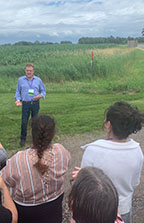
We haven’t been in the last few years, because it just hasn’t been possible for one reason or another, but we found that we had a free Saturday during the fair, with weather projected to be utterly gorgeous. We bundled up our preschoolers and headed to the Twin Cities early, to try and beat the “big” crowd, which was futile, as everyone else had the same idea.

We’ve learned a few things in our time going to the fair. First, never park next to the grounds. On truly beautiful days, those lots fill up fast, can cost quite a bit, and can be difficult to navigate to and from. Our preference is to park in an express park-and-ride lot and take the express bus right to the main gates. It’s cheaper, more convenient, and we don’t have to deal with fair traffic. This year, we parked at the Mall of America express lot across from the East Parking Garage.

I bought our transit tickets on the Metro Transit app, showed them to the friendly Metro Transit staff, and on we hopped–two adults and two preschoolers for $10, round trip. (Next year, the same trip will cost us $20 as the girls will be too old for the under five discount.)

The bus took us directly to the main entrance and Transit Hub at the back of one of the University of Minnesota St. Paul Campus parking lots. There, we could purchase tickets on site. We opted to buy ours online, and present the bar code for scanning on my phone to gain entrance to the grounds. Once inside, we headed directly for the West End Market, perched at that entrance.

The West End Market used to be Heritage Square, and traces of that history remain in a newer building that offers a displays and exhibits about the fair’s history and the art that surrounds the newer open-air stalls with goods that speak to Minnesota’s past. I stopped at the Watkins booth for vanilla extract, a staple in my kitchen. Matt took the girls to the shaved ice cart for two enormous confections that we all shared before girding our loins to head toward the Midway.

Because it was a beautiful Saturday at the fair, the crowds were challenging to navigate. I’ve seen, in the past, crowds so thick it would be easy to body surf through them. We managed, though, scooping up a bucket of fresh french fries, taking a turn at a feat-of-strength game booth, and viewing horses. We followed one lone sheep on a leash up Judson Avenue toward the international market, another favorite stop, and made use of the restrooms next to it.

(Restrooms at the fair are another big story. Fun fact: It was coverage of the 1911 Minnesota State Fair that led me to the work that would define how I approached my dissertation and later book: The Farmer’s Wife magazine. A reporter asked the editor of the Farmer’s Wife about the new restrooms on Machinery Hill at the fair, which were meant to offer farm women a respite from their corsets and other accoutrements. They were well-received.)

In recent years, big, well-maintained facilities have been added near the big market places to supplement existing restrooms, and while there will still lines on the women’s sides, the addition of family restrooms made it much easier to get in and out with two little girls who had to go, like, right now.

At the International Market, Matt took the ladies around the booths while I held a spot in the benches in front of the stage, which featured music by Papa Shalifa in the style of the Caribbean. We listened for a while, dancing, until we needed to escape the crowd and head toward the street to find some lunch.

We bought fresh, piping hot corn dogs from a truck on the corner, and turned up the road to find a spot on a bench facing the street  outside the main food building. We ate our corn dogs, drank our bottled water, and played with the new toys the girls had won at the strength booth. We watched the crowds, and I headed into the food building to get another fair favorite: deep-fried cheese curds.

The line for the curds stretched out the doors on both sides of the building, but it went very quickly. The booth is popular enough that the staff there have the procedure down. Present cash only at the window, get your ticket, then move down the counter where someone will take your ticket and hand you your curds. I got a bucket. It was a theme, OK? And we ate them all.

Keeping our spot on the street became important when  we realized the daily 2 p.m. parade was about to start. The girls clapped and waved at the bands, the farm and community princesses, the funny floats, and the Shriner’s cars. We loved watching the crowds go by.

After the parade, we ambled up another block and over to see some more of the booths, the food, and the fun. We watched people slide down the giant slide for a  minute, then looked through the merchant booths in the grandstand. We took a break, then, hanging out in the shade under the grandstand and trying to decide if we were up for doing anything else at the fair.

We decided we had to do one more thing: Get a bucket of chocolate chip cookies from Sweet Martha’s, a fair tradition that goes really well with the ice cold milk they also sell. We munched as we made our way out the same way we came in, taking the bus back to our car.

If you really want to do the entire fair, you’ll need to go more than once. That said, we managed to eat all the fair food we were craving, see a show, catch the parade, see some animals, go shopping, and enjoy the sunshine, so we felt accomplished. If you want to go, the fair runs through Labor Day. Our girls weren’t interested in the rides, but they have those, too. Have fun!
A Family Trip to Toronto

Have you ever traveled with preschoolers?

It’s an adventure.

Last week, I attended my annual discipline’s convention, AEJMC, this year held in Toronto, Ontario, Canada. I’m a member of the History Division’s leadership team, and I presented an award, judged a paper competition, and attended panels and presentations with new research in the field.

I also brought along my husband and youngest two children, both of whom are now 4. I was not alone. Colleagues with children often make the trip, as AEJMC’s convention always falls in the first two weeks of August, when many summer camps and plans are complete and school has not yet started. It gives families an opportunity for a last getaway before our calendars fill up.

In our case, it also gave our youngest an opportunity for multiple travel firsts, and we made a game of it for our younger adventurers.

First number one: Riding in an airplane.

We flew Air Canada, which is a remarkably family friendly airline. We four ended up in a row, two seats on either side of the aisle. I tucked C in by the window on my side and A sat by the window on the other side, with my husband next to her. Ahead of our trip, we packed each of them a backpack with a change of clothes, a Mifold car seat (just in case), LeapPads, and snacks. Our ladies put on their earphones and watched Mickey Mouse on the back of the seats in front of them; they thought it was a treat! We learned about how we stay buckled on a plane, but we can unbuckle if the seat belt light is off, if necessary.

C borrowed my phone to look out her window, because she was too short to see out without an extra angle. She thought the clouds were neat.

First number two: Riding on a train

A was super excited to ride a real train for the first time. We’d been on small train rides before, at amusement parks, the zoo, and a museum, but this would be the first time we took a train to actually go somewhere. We’d learned that the Union-Pearson Express train would take us directly from the airport to downtown Toronto, within blocks of our hotel, for about $10 U.S. per adult. Children under 12 ride free, which seemed like a good bargain for us. It was fast, easy, and the girls enjoyed watching the city go by “fast”.

Once at Union Station, we went outside, planning to catch a cab. We couldn’t find a taxi stand, and ended up walking the few blocks to our hotel instead. That turned out to be a good thing, as we all had the wiggles from sitting still for so long.

Our hotel had a great pool, and we spent some time in it after we found a very late lunch/early dinner underground at a Food Court that is part of the PATH system in Toronto. PATH is essentially an underground walking trail that links much of the downtown area and helps prevent having to walk outside in bad weather.

On our second day, we had first number three: Riding on a subway.

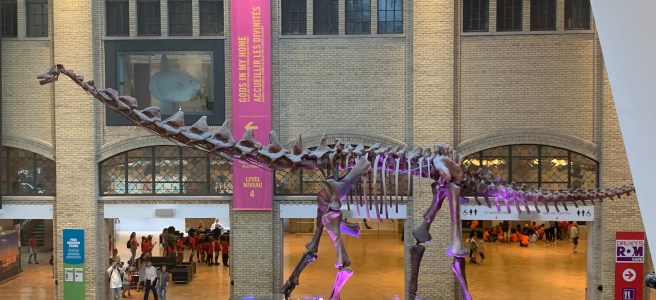
We took the subway to the Museum stop, and we headed above ground to visit the Royal Ontario Museum. Friendly museum staff directed us to the second level, which they claimed was the most popular with small children. We found that to be the case; the girls loved the dinosaurs, the children’s gallery with numerous hands-on activities, the bat cave, and the birds.

In early afternoon, we headed to the familiar Golden Arches across from the Museum for a late lunch, then took a walk around the outside of the Museum, getting ice cream cones from a truck and watching the pigeons. Eventually, we made our way back toward our hotel, and spent more time in the pool.

I was tied up with numerous conference activities on our third day, but the PATH allowed my husband to take the girls to Eaton Center, a large shopping mall that held a Disney Store as well as fountains and other fun things to see.

On our last day, the girls had first number four: Riding in a taxi.

The Mifold car seats are brilliant. They fold down into a compact rectangle that is lightweight and can easily be stowed in a backpack, but they are fully compliant with U.S. and Canadian federal safety standards. I unfolded ours, buckled the girls in, and we took a short cab ride to Roundhouse Park, which is the area right by the CN Tower, Ripley’s Aquarium, and the Railway Museum.

The Museum wasn’t yet open when we got there, but we walked around the plaza by the fountain, ate cotton candy, and eventually made our way back to Union Station to take the train back to the airport for our return trip.

When asked, the girls said their favorite part of the trip was “everything,” though A really liked the train, both liked the pool, and C really liked the plane. All in all, it was a successful first big travel adventure for all.

Strawberry Cake

My youngest turned 4 over the weekend, and she requested a strawberry cake for her birthday.

This turned out to be a little more of a challenge than originally intended. Probably influenced by our viewings of the Great British Baking Show, she wanted a giant layer cake, frosted white and topped with fresh strawberries. The cake itself also needed to be strawberry flavored and pink.

Since we were taking the cake to a family birthday party at which some family members with food allergies would be present, I needed to make it from scratch, and I needed to ensure no corn, soy, or cottonseed oil products would be included in the baking. That meant no powdered sugar, which contains cornstarch to prevent caking. It also meant a deep dive into the world of strawberry cake to find a solution.

Most strawberry cake recipes include strawberry gelatin for flavoring and color. That was a no-go for this occasion. Some recipes included pureed strawberries, cooked down for flavoring–something I didn’t really want to do, given the temperature and the humidity on baking day. Two mentioned the concept of pulverizing freeze-dried strawberries, and that the texture of the finished cake was good and flavorful, if not as moist as the kind with the pureed strawberries.

In the end, I went with a vanilla cake recipe, substituting pulverized freeze-dried strawberries for part of the flour. I baked the batter in three eight-inch layers and left them to cool while I contemplated icing.

So, buttercream would be ideal, but it contained powdered sugar, making it off-limits.

I settled on Seven-Minute Frosting, using Paula Deen’s recipe from the Food Network website.

Seven-Minute Frosting is plain white sugar, egg whites, water, and cream of tartar beaten over boiling water for seven minutes to create a thick, glossy icing that holds its shape and acts like candy when it sets. The day I was making this cake, the humidity was ridiculous, so the icing didn’t set up well at all. I persevered, however. And in doing so, I made a rather tasty mistake.

As I stacked my layers of strawberry cake, I added a layer of icing and fresh sliced strawberries between each cake, forgetting that fresh strawberries and sugar together produce syrup. It got very sloppy for a bit. I spread the icing over the top, letting it drip down the sides, and my preschoolers “helped” put the fresh cut whole strawberries, cut side down, on the top. The icing kept melting down the sides with the humidity and the chemistry, so I set it, uncovered, in the refrigerator for what amounted to about eighteen hours.

I quietly scooped frosting and strawberries off the cake plate every so often all evening, spreading them back up over the sides of the cake.

The next day, the icing had set. The cake looked pretty. And when we started to serve it, lots of wonderful things became apparent. First, the icing layers crackled as I sliced through the cake, sounding like rich candy. They weren’t too dry to cut, but provided a delicious texture with the soft berries and the rich cake. The cake itself, far from being dry, had soaked up the strawberry syrup created by my mistake. As one guest said, it tasted like old-fashioned shortcake when it had been soaked in the juices of the strawberry syrup.

We ate it all up. And the birthday girl loved it.

If you try it, I used the vanilla cake recipe found here. I used an entire 0.8 oz bag of freeze dried strawberries, blending them until they resembled flour. I spooned the strawberry dust into a one-cup measure, then added enough all-purpose flour to the cup to fill it up, incorporating it into the flour quota for the recipe.


From LaCrosse to Pepin on the Great River Road, and LauraPalooza too!

LauraPalooza is one of my favorite places to go. A convention wholly dedicated to amalgamating the world of Laura Ingalls Wilder fans, scholars, and researchers, the event is sponsored by the Laura Ingalls Wilder Legacy and Research Association and is held every two to three years.

This year, the gathering convened in the LaCrosse, Wis., area with an eye toward a visit to Pepin, Wis., on the last day. Pepin is closest to where Laura was born in a small cabin about seven miles northeast of the town, which is located on the banks of Lake Pepin, an exceptionally wide spot of the Mississippi River.

I wasn’t able to attend all of this year’s convention, but I arrived Tuesday afternoon in time to hear the last few presentations, including a Q and A with Wilder expert William Anderson. Wednesday morning offered presentations about the psychology of the mother-daughter relationship, the “missing” Grace Ingalls,  and an entertaining presentation about the route taken by Laura and Almanzo from De Smet, S.D., to Mansfield, Mo., in 1894.

The afternoon, however, was taken up with the trip to Pepin.

I drove myself, and headed straight up the Great River Road to do so. The route, 75 miles from LaCrosse to Pepin on Highway 35, takes drivers through numerous small towns that sprung up along the Mississippi River during its heyday as the main means of travel in the area. The Mississippi still welcomes boat traffic, and in fact, it’s an active thoroughfare. The views along the way are spectacular, and each little town does its best to help travelers on their way.

I stopped in Nelson at the Nelson Cheese Factory on the way (on the recommendation of LIWLRA Homesite Representative Lynn Urban) and enjoyed a white chocolate raspberry ice cream cone. It’s a cozy place that also offers a variety of lunch items, coffee, wine, and assorted other products that make it an ideal place to get a snack and stretch my legs.

I then made my way through Pepin to the Laura Ingalls Wilder Birthplace Wayside.

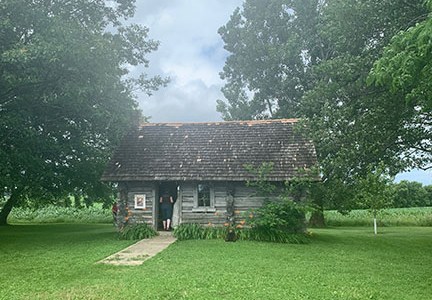
I’ve been there several times, first in 1990 as a fresh-eyed 18-year-old on her first road trip without parents. That was nearly exactly 29 years ago. The little cabin that marks the site has been replaced once since then, and its sturdy construction, nestled in among the trees that have really grown in the last thirty years, made it look cozy.

LIWLRA and local host volunteers Susan Goettl and Julie Miller dressed the part for the event, staffing the cabin in their calico dresses and bonnets, and they dressed the cabin as well. Normally, it’s open to visitors but left empty to keep things from walking off. As a treat on Wednesday, however, Miller and Goettl had dressed the cabin, as well, making it appear as cozy as it might have in Laura’s day.

One special treat came from Anderson, who came along on the tour.

bill
Bill Anderson points out the general area where the original cabin was located.

He pointed out the general area that the original cabin had once stood, several feet southwest of the replica in a spot roughly near the wayside driveway’s entrance. A little rain kept umbrellas up, but it didn’t dampen the enthusiasm the crowd had for learning something new about Laura.

That stop kicked off the afternoon, which also featured a visit to the Museum in town, which had Wilder exhibits and merchandise. I also drove down toward the lake, up to the town park named after Wilder, and out to the farmer’s stand on the corner of the GRR and County CC, which takes visitors out to to the homesite.

Also scheduled were guided visits of the Oakwood Cemetery, where several significant people are buried, a supper, and a dance to mimic the Dance at Grandpa’s featured in Laura’s book, Little House in the Big Woods. Knowing I had to drive all the way home, however, meant I had to leave earlier than anticipated. I missed the dance, but I heard that it was a good time.

The Great River Road is always open for traveling, and a fun, leisurely drive to take. It’s not necessary to pair it with a trip to Pepin, but it’s always interesting to make that stop.

And as for LauraPalooza? The next convention will be near Malone, New York, birthplace of Almanzo Wilder, in summer, 2022. I’m already saving up.

Just Two Weeks to LauraPalooza

So I’m pretty late in getting my registration in, but I’m excited to be heading to LauraPalooza in two weeks. While I won’t be able to go for the entire three-day conference, I’m really looking forward to the day that I’ll be there.

The program shows a set of research presentations that focus on Rose Wilder Lane and on On the Way Home, and a bus trip to Pepin with special programming. I look forward to seeing some of my Laura friends, too.

That entire week will include not only LauraPalooza, but a road trip to Walnut Grove over the weekend to attend the Little House television show cast reunion. Guests will include two of my favorite people, Alison Arngrim and Dean Butler, as well as several original cast members. One, Radames Pera, also played the young Kwai Chang Caine in Kung Fu, and my husband (a martial artist) is excited to get his autograph.

I know several other Laura friends who plan to make the whole week one long Laura trip. And as Alison recently said on Twitter, it will be “amazeballs!”

Keep an eye on this space to hear more about it when it happens.

Summer Fun Begins at Como Park

Memorial Day marked the beginning of summer for my family, and we started our summer last week with a day trip to Como Park Zoo & Conservatory, a perpetual family favorite.

I don’t have clear memories of my first trip to Como because it’s a place my family’s gone to since I was tiny, myself. This large, gorgeous park was constructed between 1891 and 1922, and it remains a staple of family life for anyone near the Twin Cities area. Admission to the zoo and conservatory is free, though donations are gratefully accepted for the work of maintaining the park and for the conservation programs to which the organization contributes.

The grounds have evolved a bit since their earliest construction. Our favorite place to park is at the West Picnic Grounds, which are closest to the zoo and conservatory, contain a well-maintained toilet facility, and include a playground suitable for children ages 3 and up. We like to take a picnic to one of the many picnic tables at the grounds and eat before heading into the zoo at its main entrance.

The main entrance features several well-maintained carnival rides for all ages, for fees that help offset the costs. It’s a fun place to start, or end, the trip. The zoo itself is small, and easily walkable, but features a variety of animals in clean, appropriate habitats. Last week, we saw the tigers, giraffes, gorillas, orangutans, polar bears, bison, zebras, penguins, and many other animals, large and small. The zoo’s popular sea lion exhibit and show is on hiatus this summer, as the entire area devoted to aquatics is under construction and slated to reopen in 2020.

However, that’s not really a deterrent for visitors. The day we were there last week, the temperatures were pleasant and the park was full of school groups taking their end-of-year field trips. We enjoyed a visit to the conservatory as well as the zoo, and my preschoolers loved the children’s gallery inside that allowed them to play with water in an exhibit about planting.

C in particular liked seeing all the plants in the conservatory. She loved the sunken garden, laughed under the spray in the fern room, and excitedly gasped at the sight of a cacao tree. Both girls loved the Japanese garden, and the area that let them build their own paths in puzzle form.

We were mildly disappointed that the butterfly house was not yet ready for visitors; visits in the past have been favorites. But it’s early in the season for butterflies, and the house will open June 15.

Finally, though mine are not yet excited about the big carousel, I’ll relate that it’s one of my favorite places, and has been since I was small. For $2, take a ride on Cafejian’s Carousel, named for the man who helped rescue and restore it. Built in 1914, the carousel features 68 horses.

We finished off our day with ice cream and play at the playground. Como itself is much larger than our day would suggest; the total grounds feature a lake with walking trails and a golf course nearby. Locals enjoy much more than the zoo. But it’s well worth a visit.

If you go: Concessions are available at the park, and it’s all that luscious carnival food you might love. It’s also pricy, as concessions are one way the park is able to maintain a free admission policy. I generally choose to simply “eat” the cost as a contribution to the park, but if money is a concern for you, take a picnic. The grounds are lovely. Just don’t feed the animals.

The Pace of Change in U.K. Media: 26 years later

My trip to London in March gave me numerous opportunities to research and play tourist, and one of the things I planned to observe on my return there–after more than 26 years, actually–was how the media landscape had changed.

Some changes were blazingly obvious: Nearly every transaction I undertook in my 2019 trip involved my phone. In 1992, I had access to a single pay phone and a calling card that I could afford to use once a week, on Sundays, to talk to my family for about fifteen minutes. In 2019, my cell phone stayed almost constantly in my hand, and while calls were significantly cheaper than in 1992, I actually used it most for everyday things. I had constant access to information on it, and I think I used the Maps feature the most. I could, and did, map out a walk or a transit route to the places I wanted to go, and it steered me right every time.

In 1992, I got lost on Fleet Street, though I did eventually find my way back to the Tube station by looking at all the clearly marked signs in the city center, I appreciated the 2019 map-at-hand. It even told me when there were delays on the trains, construction on streets that could slow traffic, and blocked sidewalks.

It was brilliant.

Tickets to the play I went to were confirmed to my phone. My London Explorer Pass actually came with an app that allowed me to get tickets electronically, then helpfully kept track of the places I’d gone and had yet to go. While I bought an Oyster card for use on the public transit in London, I could also have downloaded an app to have the card on my phone, something I made note of for later trips.

I looked up museum hours and locations, made split second decisions and choices about where I’d go based on information I found in my hand, and occasionally paid for a taxi with my mobile wallet. I also used it to text, take pictures, and converse with my family in the States over video chat.

I do use my phone regularly for most of these things in the States, too, but the ease of use in 2019 Britain really highlighted the speed of the changes that have taken place since 1992.

A second, less obvious media change lay in the television choices.

In 1992, Harlaxton College had one television room, and limited channels. My host family in town had one television, and one license for it. Programming was fairly limited. The idea that televisions had to be licensed seemed novel to me at the time.

In 2019, I didn’t even notice a difference in programming, frankly. My hotel rooms each had a television with dozens of channels and access to Netflix and other streaming services. My friend’s home had a television with cable and WiFi access.

Programming wasn’t a focus on of my trip at all. However, I noted that BBC Radio still is going strong with original programming, the local media landscape is rich with original work, and British programs in general remain popular. I was happy to see I could take my favorite home with me; “The Great British Bake-Off” now can be viewed on Netflix. And I think that might be the biggest takeaway. There’s a LOT of crossover programming available in both countries in a way there wasn’t in 1992. Except for limited BBC partnerships with PBS, things seemed pretty restricted in 1992. That isn’t the case in 2019.

Finally, I noticed a decided preference in Britain for paperless transactions. While cash is still accepted most places, most Brits have chip-and-pin cards they use for virtually all transactions. It’s rare to find a place that isn’t equipped to handle the cards, and occasionally I got a clear look of “ah, yes, you’re a tourist” when I pulled out cash. (Cash, because it was cheaper for me to take a hit on currency conversion pulling cash once from an ATM than it was to take the individual fees that occurred with each cashless transaction in a different country.)

Food for thought.

Reflections on Research, and the Culture War being played out in Media

I’ve been updating the web site today, organizing pages (there’s now a page for Research in the UK and another for Laura Ingalls Wilder posts), and it made me consider the trajectory of my research thus far.

One of my particular early challenges was what appeared to be an inability to settle on a research area. It’s fairly clear by the volume and variety of subjects that I’ve written about that I enjoy a wide variety of interests. It took some time for me to settle on what has become the through-line, however, and that is actually fairly simple:

How do people underserved by traditional media platforms use media to build their own communities, bolster their own political power, and effect change?

“Underserved” is an interesting word. To use it means acknowledging that traditional mainstream media do not serve the same function for particular classes and groups of people that they do for those who are in control of the messages spread by it. It implies that mainstream media reinforce a status quo when it comes to power and control. Thus, people who recognize that they are not served by traditional media turn to other means by which they can get messages into the morass of mediated communication.

Today, this can be achieved through the construction of a relatively cheap web site, the networking of varied social media platforms, and the ability of those who want to get a non-mainstream message out to find like-minded people to help with those networks.

Such sites still face a credibility problem, because, of course, one way to maintain the status quo is to immediately downplay, discredit, and label messages that contradict the status quo as “not credible.” (Or, perhaps, “fake.”)

Originally, I was interested in how new media platforms (when they were new, in the late 1990s) would work alongside their traditional counterparts (newspapers, magazines.)

But as I dug more deeply, I realized that how media platforms are used, and for what purpose, is as important, or more so, than the mere fact that they exist. Local newspapers, for example, exist to provide news and information of local interest to the community, to build communal structures for communication across the area, and to provide common ground for discussion in public spaces.

National and international news platforms are meant to do the same, in a larger sphere, reinforcing public status quo at that level.

But the splintering of media platforms has meant that media consumers can choose, to a greater or lesser degree, which platforms they want to listen to. This has lead to more and more media consumers choosing to “listen” or pay attention to only those platforms that agree with their particular views of what the status quo should be. That has led to general upheaval, because in a world where many voices can be heard, with many ideas about how things should be, people have stopped listening to any voices that might contradict their own.

Thus, a culture war being played out on the public stage.

I mentioned, once, that I view history as music, in a way. Each chord reflects the voices of thousands, at all levels of society in all forms, and each is utterly necessary to create the music that is culture and structure in society.

Suppression of voices will mean instability.

Well. I don’t know that I’ve made any sense in this bit of exploratory writing. It’s tough to boil some of these thoughts down. But what I’m generally thinking, given the work I have done and will continue to do in exploring how underserved populations have found their voices and expressed them, using media platforms to build community and effect change, is that real social and political change can only come when the voices of the underserved are made manifest–and one listens to the stories they can tell.

Last Day in London: St. Paul’s Cathedral, the London Wall, and the Museum of London

I arrived in London shortly after noon by train from Manchester, and had to make the critical decision about what to do with my last afternoon. I decided to combine two things that exist fairly close to each other: St. Paul’s Cathedral and the Museum of London.

As one docent put it, St. Paul’s claims the honor of being the people’s church. When great tragedy befalls England, people flock to the cathedral for solidarity, fellowship, and prayer. This version of the cathedral dates to just after the Great Fire of London in 1666, which took out most of the city proper. Redesigned by legendary architect Christopher Wren (who is interred there), building is constructed in the shape of a cross and contains the only dome of its kind.

The steps of St. Paul’s beckon to all (and are featured in Mary Poppins), and the day I was there, the space was reasonably crowded with visitors. Despite the crowd, the cathedral retains its status as a place of worship, as visitors are reminded on the hour with a moment of silence and prayers. I took the self-guided audio tour to learn about the art, architecture, and people of St. Paul’s, and I felt moved.

At the high altar, I lit a candle for those I have lost this year, including my mentor, Hazel Dicken-Garcia. I was moved to tears, and knelt in prayer until I calmed, before heading below to the crypt, cafe, and gift shop, to take a break.

Replenished, I walked up to the Museum of London. It’s a relatively short walk, though right at the site I got confused about where to go to get into the Museum itself. Finally, I figured out I had to go up, and that made all the difference. I found the escalator entrance that took me to the third level of the Museum, which built around the remnants of ancient city walls.

Inside, I wandered through exhibits that focused on the history of the city from its earliest roots. They feature artifacts from every period available, from the Neolithic to Roman, from Medieval to Victorian, and from Industrial to the present day. I think my favorite was the Victorian walk, set up to appear like a small neighborhood in Victorian London. I also enjoyed the current exhibition on women’s suffrage in London.

Finally, I wandered out along the old city wall path to get to Moorgate, the tube station that took me back to the train station for my left luggage. Utterly exhausted at this point, I opted not to take tube and train back out to Heathrow (near which I had hotel reservations) and chose instead to take the more expensive but less stressful taxi option. My driver was pleasant and the drive out went smoothly. Our route took us past the William Hogarth House and Chiswick Gardens, which I earmarked for my next trip.

Getting around: I chose to use public transportation for most of my trip. It’s relatively inexpensive (I spent about $50 on tube and bus fares over two weeks) and easy to figure out. Put your walking feet on, though. And if you have mobility issues, be aware that not all tube stations have handicapped accessibility. I took a lot of stairs, and that did take a toll on my aging knees. Still, it was overall a great experience.

Last Day in Manchester: Museum Of Science And Industry and Castlefield

For my last full day in Manchester, I decided to head to the Museum of Science and Industry, a museum that grew around the oldest train station in the world.

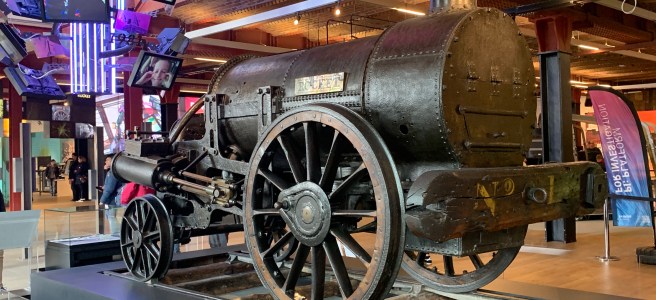
The 1830 station is currently closed for refurbishment and exhibition installation, so that was a bit disappointing. However, to make up for that lack, the museum currently houses Stephenson’s Rocket, the engine that won the Rainhill trials to become the model for the train engines that would service the brand new Liverpool-Manchester trainline.

It’s the kind of item that has something of a folk status in Manchester, so the crowds around the engine for each of the six presentation talks given about it during the day were relatively thick. We learned that the engine, once yellow, had gone black with age, and we learned about the missing bits that had been repurposed into other train engines.

Beyond the Rocket, however, I found a lot more to appreciate about the museum. An entire section deals with the history of the textile industry in Manchester, and focuses on the process, equipment, and social issues surrounding the incredibly fast increase in population as workers flooded to Manchester for jobs at the turn of the 19th century. There’s also an area full of fun experiments and activities for children to try.

Other exhibits include the first programmable computer, built by two Manchester scientists, a Power Hall full of the machinery designed to create and get power to other machinery as part of the Industrial Revolution, and a look at the 1830 warehouse, across the tracks from the 1830 train station, that remains the oldest in Manchester.

The Air and Space Hall, across the street and affiliated with the Museum, also was closed for repair. But as I wandered away, I found a section of the city that I’d hoped to see and sort of forgotten: Castlefield.

The reconstructed North Gate of the old Roman fort faces a small square that includes a weathered foundation reconstruction of original Roman village. I wandered around those foundations, took pictures of blooming tulips and of the Gate, and continued my wandering.

Manchester will be a place I return. The warmth of the people, the rich history of the area, and the excellent access to city amenities make it an ideal destination. I look forward to bringing my own children some day.